MinuteRead
30 min
Book summary
by Hersh Shefrin
Premium summary · Opens in the app · 30 min read
For decades, the world of finance operated under a comfortable assumption: that people, when it comes to money, behave rationally. The models said so. The equations assumed it. The entire edifice of modern financial theory rested on the idea that investors process information efficiently, weigh risks and rewards objectively, and make decisions that maximize their own best interests.
**Author:** Hersh Shefrin
**Estimated Reading Time:** 45 minutes
**What You'll Learn:** How psychological forces shape every corner of the financial world, from individual investment decisions to corporate takeovers, and how recognizing these forces can help you make better financial choices.
**Who This Book Is For:** Investors, portfolio managers, financial advisors, corporate executives, and anyone who wants to understand why financial markets behave the way they do and how to protect themselves from their own psychological blind spots.
For decades, the world of finance operated under a comfortable assumption: that people, when it comes to money, behave rationally. The models said so. The equations assumed it. The entire edifice of modern financial theory rested on the idea that investors process information efficiently, weigh risks and rewards objectively, and make decisions that maximize their own best interests. Then reality kept intruding. Why did investors hold onto losing stocks far too long while selling winners too quickly? Why did corporate executives overpay for acquisitions that destroyed shareholder value? Why did professional money managers chase trends that they knew, intellectually, were unsustainable? Why did entire markets swing from euphoria to panic with a regularity that no rational model could explain? Hersh Shefrin, a pioneer in the field of behavioral finance, offers a compelling answer: because human beings are not calculating machines. We are psychological creatures, driven by desires, fears, biases, and mental shortcuts that operate below the level of conscious awareness. We are, as Shefrin puts it, subject to forces that go beyond greed and fear. This book is not an academic exercise. It is a practical guide for anyone who makes financial decisions, which is to say, everyone. Shefrin writes for portfolio managers who need to understand why their clients make irrational demands. He writes for individual investors who wonder why they keep making the same costly mistakes. He writes for corporate executives who need to recognize the hubris that leads to disastrous mergers. He writes for analysts who must confront the limitations of their own forecasting abilities. The central insight is both simple and profound: psychology permeates the entire financial landscape. It affects how we process information, how we frame decisions, how we assess risk, and how we interact with markets. The errors we make are not random. They are systematic, predictable, and, once recognized, potentially avoidable. Traditional finance treats the market as a collection of rational actors. Behavioral finance treats the market as a collection of human beings, with all the cognitive limitations and emotional complexities that entails. The difference is not academic. It has real consequences for how we invest, how we manage risk, and how we understand the financial world around us. Shefrin's approach is distinctive because he does…
Continue reading in the MinuteRead app
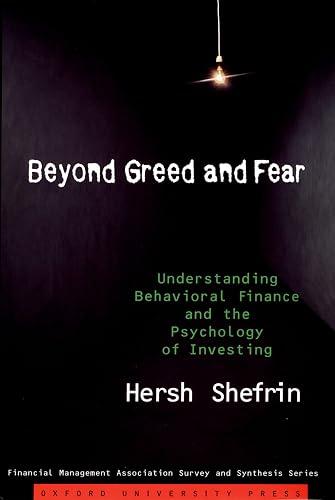
Get the complete 30-minute summary of Beyond Greed and Fear
Get the complete summary in the appPsychology affects every financial decision, from individual investments to corporate takeovers.
Heuristics are mental shortcuts that lead to predictable errors in judgment.
Loss aversion makes losses feel twice as painful as equivalent gains.
Frame dependence means how a choice is presented affects how we perceive it.
Market inefficiency arises when biased decisions aggregate to move prices.
Confirmation bias keeps us clinging to beliefs the evidence does not support.
"Beyond Greed and Fear" is a strong fit if you want practical ideas around finance, business, psychology, especially themes like psychology affects every financial decision, from individual investments to corporate takeovers; heuristics are mental shortcuts that lead to predictable errors in judgment. The MinuteRead summary distills these concepts into a focused read, whether you're deciding whether to buy the book or applying its lessons at work.
Motivated to help readers with this book is about recognizing the influence of psychology on oneself, Hersh Shefrin wrote “Beyond Greed and Fear” to package those ideas for a fast, focused read. In “Beyond Greed and Fear”, Hersh Shefrin focuses on this book is about recognizing the influence of psychology on oneself. Through “Beyond Greed and Fear”, Hersh Shefrin distills the core ideas on finance into lessons readers can absorb in a single short sitting. Readers turn to this work when they want…
Continue Reading
Access the complete 30-minute summary and thousands more nonfiction books in the MinuteRead app.

Continue reading the complete summary in the MinuteRead app.