MinuteRead
30 min
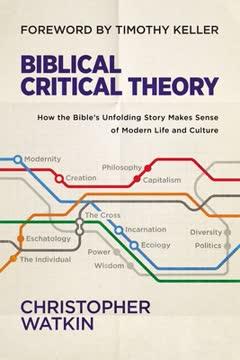
Book summary
Premium summary · Opens in the app · 30 min read
We live in an age of competing stories. Every day, we encounter claims about what it means to be human, what constitutes a good society, and where history is heading. These stories come from politicians, advertisers, social media, universities, and entertainment. They shape our desires, our fears, and our sense of what is possible.
**Author:** Christopher Watkin **Estimated Reading Time:** 45 minutes
**What You'll Learn:** How the Bible provides a sophisticated and compelling framework for understanding culture, politics, relationships, and the deepest questions of human existence. You will discover how biblical concepts like covenant, exodus, prophecy, and the Trinity do not simply oppose modern ideas but offer richer alternatives that transcend our most entrenched debates.
**Who This Book Is For:** Anyone who senses that our cultural conversations are stuck in repetitive loops. Christians who want to engage culture with depth rather than slogans. Skeptics curious about whether the Bible offers intellectual resources worth considering. Leaders, artists, students, and citizens who want to think carefully about the world we inhabit.
We live in an age of competing stories. Every day, we encounter claims about what it means to be human, what constitutes a good society, and where history is heading. These stories come from politicians, advertisers, social media, universities, and entertainment. They shape our desires, our fears, and our sense of what is possible. Most of us navigate this landscape without a clear framework. We absorb ideas piecemeal. We react. We feel pulled between extremes: optimism and cynicism, individualism and collectivism, justice and mercy, freedom and obligation. The conversations that dominate our public life often feel like a pendulum swinging between two inadequate options. Christopher Watkin proposes something unexpected. He argues that the Bible, when read as a coherent narrative, provides a way of seeing reality that is more intellectually satisfying and practically fruitful than the stories our culture tells. This is not a book about how Christians should withdraw from culture or simply condemn it. It is a book about how the biblical story equips us to understand culture more deeply and engage it more constructively. The term "critical theory" might sound academic, but at its heart, it refers to the practice of examining the stories a society tells about itself. Critical theory asks: Who benefits from these stories? What do they hide? What assumptions do they make? Watkin shows that the Bible has been doing this kind of work for millennia. The prophets critiqued kings. The law limited power. The gospel inverted status hierarchies. The biblical authors understood that human societies are built on narratives that need to be examined. But biblical critical theory does something that secular critical theory cannot do. It not only diagnoses problems. It offers a coherent vision of what healthy human life looks like. It not only deconstructs. It reconstructs. It not only critiques power. It provides a basis for hope. This matters because we are exhausted by critique without alternatives. We have become skilled at identifying what is wrong. We are less skilled at articulating what would…
Continue reading in the MinuteRead app
Get the complete 30-minute summary of Biblical Critical Theory
Get the complete summary in the appThe Bible's narrative structure is creation, fall, redemption. This framework makes sense of everything.
The Trinity means relationship is fundamental to reality. We are made for communion, not isolation.
Covenant is not contract. God's relationship with us is based on superabundant grace, not calculation.
The exodus is liberation for the sake of service, not autonomy. Freedom is redirection of obligation toward God.
Prophets have authority without power. They speak truth to power and include themselves in the need for change.
The king is under the law. No human authority is absolute. All power must be limited and accountable.
"Biblical Critical Theory" is a strong fit if you want practical ideas around theology, christian, christianity, especially themes like the bible's narrative structure is creation, fall, redemption. this framework makes sense of everything; the trinity means relationship is fundamental to reality. we are made for communion, not isolation. The MinuteRead summary distills these concepts into a focused read, whether you're deciding whether to buy the book or applying its lessons at work.
Christopher Watkin is a lecturer in French Studies at Monash University, specializing in contemporary French thought, atheism, and religion. He has authored several books on philosophy and theology, including "Difficult Atheism" and "Michel Foucault." Watkin's work focuses on integrating Christian theology with contemporary philosophical and cultural issues. He is known for his ability to bridge complex philosophical concepts with biblical understanding, making them accessible to a broader audie…
View all summaries by Christopher WatkinContinue Reading
Access the complete 30-minute summary and thousands more nonfiction books in the MinuteRead app.

Continue reading the complete summary in the MinuteRead app.