MinuteRead
30 min
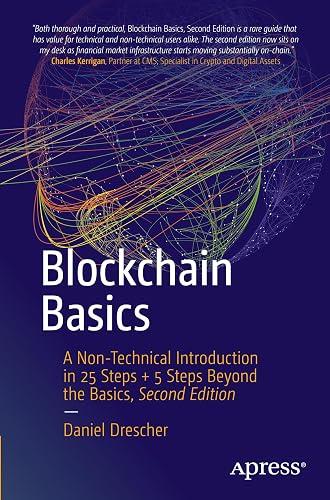
Book summary
by Daniel Drescher
Premium summary · Opens in the app · 30 min read
Every so often, a technology emerges that forces us to reconsider assumptions we did not even know we were making. The blockchain is such a technology. It challenges one of the most deeply embedded assumptions in modern life: that when two parties who do not know or trust each other want to transact, they need a third party they both trust to facilitate the exchange.
**Author:** Daniel Drescher
**Estimated Reading Time:** 45 minutes
**What You'll Learn:**
- Why the blockchain represents a fundamentally new way to establish trust between strangers - How cryptographic building blocks combine to create tamper-resistant records - What consensus mechanisms are and why they matter - How mining and economic incentives keep decentralized networks secure - Where blockchain technology can be applied beyond cryptocurrencies - What limitations and challenges remain unsolved
**Who This Book Is For:**
This book is for anyone who wants to understand blockchain technology without wading through dense technical documentation or mathematical proofs. Whether you are a business professional evaluating blockchain applications, a student exploring emerging technologies, an investor seeking deeper understanding, or simply a curious reader who wants to know what the fuss is about, this condensed edition will give you a genuine working knowledge of how blockchains function and why they matter.
Every so often, a technology emerges that forces us to reconsider assumptions we did not even know we were making. The blockchain is such a technology. It challenges one of the most deeply embedded assumptions in modern life: that when two parties who do not know or trust each other want to transact, they need a third party they both trust to facilitate the exchange. Consider how much of our daily lives depends on trusted intermediaries. Banks verify that we have money before we spend it. Governments maintain registries of who owns which property. Credit card companies stand between buyers and sellers, vouching for both. Social media platforms verify our identities and police our interactions. Each of these institutions exists because, historically, there was no reliable way for strangers to coordinate without a central authority keeping the records straight. This reliance on intermediaries comes with real costs. Intermediaries charge fees. They create bottlenecks. They become single points of failure. They can be corrupted, hacked, or simply mismanaged. They accumulate enormous power over the people who depend on them. And in many parts of the world, trustworthy intermediaries simply do not exist, leaving billions of people unable to participate fully in the global economy. The blockchain offers an alternative. It is a technology that allows a group of strangers, none of whom need to trust any of the others, to collectively maintain a record of transactions that everyone can rely on. It achieves this not through central authority but through clever design, cryptography, and economic incentives. The result is a system where trust emerges from the network itself rather than being imposed from above. Daniel Drescher wrote Blockchain Basics to address a specific problem: most explanations of blockchain technology are either too technical for general readers or too shallow to provide genuine understanding. Engineers describe…
Continue reading in the MinuteRead app
Get the complete 30-minute summary of Blockchain Basics
Get the complete summary in the appThe blockchain solves the problem of maintaining a trustworthy shared record without any central authority.
Trust in the blockchain comes from mathematics and incentives, not from trusting people or institutions.
Hash functions create digital fingerprints that make tampering detectable.
Digital signatures prove ownership and authorize transactions without revealing secrets.
The blockchain is an append-only record where altering the past requires altering everything after it.
Consensus mechanisms allow distributed networks to agree without central coordination.
"Blockchain Basics" is a strong fit if you want practical ideas around technology, computer science, business, especially themes like the blockchain solves the problem of maintaining a trustworthy shared record without any central authority; trust in the blockchain comes from mathematics and incentives, not from trusting people or institutions. The MinuteRead summary distills these concepts into a focused read, whether you're deciding whether to buy the book or applying its lessons at work.
Motivated to help readers with the core problem to be solved by the blockchain is achieving and maintaining integrity in a purely, Daniel Drescher wrote “Blockchain Basics” to package those ideas for a fast, focused read. In “Blockchain Basics”, Daniel Drescher focuses on the core problem to be solved by the blockchain is achieving and maintaining integrity in a purely. Through “Blockchain Basics”, Daniel Drescher distills the core ideas on technology into lessons readers can absorb in a single …
Continue Reading
Access the complete 30-minute summary and thousands more nonfiction books in the MinuteRead app.

Continue reading the complete summary in the MinuteRead app.