MinuteRead
30 min
Book summary
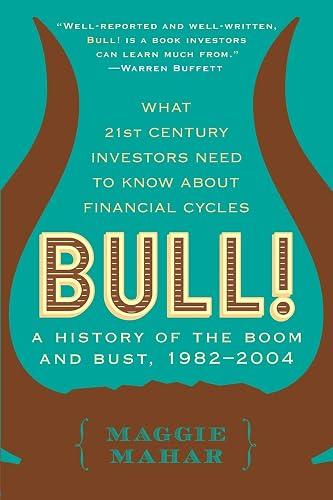
by Maggie Mahar
Premium summary · Opens in the app · 30 min read
In the spring of 1999, a bookseller named Amazon.com was valued at more than the combined worth of every bookstore chain in America. A company called Priceline, which had never earned a profit, briefly surpassed the market capitalization of United Airlines, Northwest Airlines, and Continental Airlines combined. Investors crowded into mutual funds that promised 30 percent annual returns as though such numbers were a birthright rather than a fantasy.
**Author:** Maggie Mahar **Estimated Reading Time:** 45 minutes
**What You'll Learn:**
* How the greatest bull market in American history was built on a foundation of collective delusion * Why individual investors, Wall Street analysts, fund managers, and the Federal Reserve all played roles in creating the bubble * How corporate accounting became a tool for deception rather than transparency * Why technological innovation does not guarantee investment returns * What the boom and bust cycle reveals about human psychology and market behavior * How to recognize the warning signs of speculative mania before it destroys wealth
**Who This Book Is For:**
Anyone who invests in the stock market, manages retirement savings, follows financial news, or wants to understand how economic bubbles form and burst. This book is essential reading for individual investors who lived through the dot-com era, younger investors who only know the aftermath, and anyone who believes that "this time is different."
In the spring of 1999, a bookseller named Amazon.com was valued at more than the combined worth of every bookstore chain in America. A company called Priceline, which had never earned a profit, briefly surpassed the market capitalization of United Airlines, Northwest Airlines, and Continental Airlines combined. Investors crowded into mutual funds that promised 30 percent annual returns as though such numbers were a birthright rather than a fantasy. The stock market had become the central obsession of American life. Taxi drivers offered stock tips. Hairdressers debated the merits of technology IPOs. Retirees mortgaged their homes to buy shares in companies whose business models even their founders struggled to explain. The collective conviction that stocks could only go up had transformed investing from a disciplined practice of valuation and patience into a feverish pursuit of momentum. Maggie Mahar's "Bull" tells the story of how this happened. But it is not merely a history of the dot-com bubble. It is an anatomy of collective delusion, a detailed examination of how intelligent people convince themselves that impossible things are true, and how institutions designed to protect investors instead became engines of destruction. The book begins in 1982, when the great bull market was born out of the ashes of a brutal bear market. It follows the market's rise through the Reagan years, the crash of 1987, the recession of the early nineties, and the extraordinary acceleration of the late nineties. It ends with the bust, the slow unraveling of trillions of dollars in wealth, and the painful reckoning that followed. Mahar's central insight is uncomfortable: the bull market was not primarily an economic phenomenon. It was a psychological one. The market rose because people believed it would rise. That belief created its own reality, at least for…
Continue reading in the MinuteRead app
Get the complete 30-minute summary of Bull
Get the complete summary in the app**Markets go down because they went up.** The forces that drive a bull market contain the seeds of its destruction.
**Bull markets are psychological phenomena.** They are driven by collective belief and momentum, not by fundamental valu
**No one is in charge.** The Federal Reserve, Wall Street analysts, and fund managers cannot protect you from losses. Yo
**Great technologies do not necessarily make good investments.** Most of the value created by technological revolutions
**Financial statements are marketing materials.** Corporate executives have strong incentives to present favorable resul
**Professional management does not guarantee good results.** Fund managers and analysts face incentives that may not ali
"Bull" is a strong fit if you want practical ideas around finance, economics, history, especially themes like **markets go down because they went up.** the forces that drive a bull market contain the seeds of its destruction; **bull markets are psychological phenomena.** they are driven by collective belief and momentum, not by fundamental valu. The MinuteRead summary distills these concepts into a focused read, whether you're deciding whether to buy the book or applying its lessons at work.
Motivated to help readers with "Markets go down because they went up, Maggie Mahar wrote “Bull” to package those ideas for a fast, focused read. In “Bull”, Maggie Mahar focuses on "Markets go down because they went up. Through “Bull”, Maggie Mahar distills the core ideas on finance into lessons readers can absorb in a single short sitting. Readers turn to this work when they want Maggie Mahar's perspective on the subject without working through the entire original volume. Maggie Mahar wrote “Bul…
Continue Reading
Access the complete 30-minute summary and thousands more nonfiction books in the MinuteRead app.

Continue reading the complete summary in the MinuteRead app.