MinuteRead
30 min
Book summary
Premium summary · Opens in the app · 30 min read
You can survive about three weeks without food. You can manage roughly three days without water. You can hold your breath for perhaps three minutes before losing consciousness. But you cannot go even three seconds without thinking. Your mind never stops. It churns through worries at midnight, replays awkward conversations from years ago, and imagines disasters that will probably never happen. This constant mental activity is not a flaw in your design. It is the very nature of being human. Yet fo
**Author:** Caroline Leaf
**Estimated Reading Time:** 45 minutes
**What You'll Learn:** How your thoughts physically shape your brain, why mind management matters more than you think, and a practical five-step method to break toxic thinking patterns and build lasting mental health.
**Who This Book Is For:** Anyone who feels trapped by anxious thoughts, recurring worries, or painful memories. If you have ever felt that your mind is working against you, this book offers a scientifically grounded path toward taking back control.
You can survive about three weeks without food. You can manage roughly three days without water. You can hold your breath for perhaps three minutes before losing consciousness. But you cannot go even three seconds without thinking. Your mind never stops. It churns through worries at midnight, replays awkward conversations from years ago, and imagines disasters that will probably never happen. This constant mental activity is not a flaw in your design. It is the very nature of being human. Yet for most people, this endless stream of thought feels less like a gift and more like a prison. The problem is not that you think too much. The problem is that nobody taught you how to think about your thinking. You learned mathematics, grammar, and history in school, but you probably never received a single lesson on managing the organ that processes all of that information. You were expected to figure out your mind on your own, through trial and error, while navigating the ordinary stresses of growing up, building relationships, pursuing a career, and coping with loss. The result is predictable. Millions of people walk around with minds full of unexamined thoughts, unprocessed pain, and unconscious patterns that shape their decisions, relationships, and health in ways they do not understand. Caroline Leaf, a cognitive neuroscientist with decades of research on the mind-brain connection, argues that this ignorance is not just unfortunate. It is dangerous. Unmanaged thinking does not stay contained in your head. It spills into your body, altering your hormones, weakening your immune system, and even changing the expression of your genes. Toxic thoughts are not abstract events. They are physical realities with measurable consequences. The good news is that the reverse is also true. Healthy, intentional thinking can rebuild what toxic thinking has damaged. Your brain is not fixed. It is constantly changing, and you are the one directing that change, whether you realize it or not. This book exists to make that process conscious. It introduces a method called the Neurocycle, a five-step approach to mind management that Leaf developed through her clinical work and research. The Neurocycle is not a quick fix or a positive-thinking slogan. It is a structured practice, grounded in…
Continue reading in the MinuteRead app
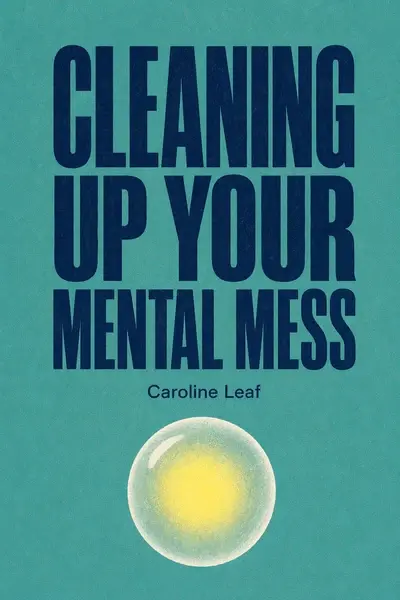
Get the complete 30-minute summary of Cleaning Up Your Mental Mess
Get the complete summary in the appYour mind is not your brain. Your mind uses your brain as a tool.
Thoughts are physical structures in your brain, built by repetition.
You can change your brain by changing your thoughts.
The Neurocycle has five steps: Gather, Reflect, Write, Recheck, and Active Reach.
Writing is essential. Do not skip it.
It takes about 63 days to turn a new thought into a habit.
"Cleaning Up Your Mental Mess" is a strong fit if you want practical ideas around health & fitness, self help, psychology, especially themes like your mind is not your brain. your mind uses your brain as a tool; thoughts are physical structures in your brain, built by repetition. The MinuteRead summary distills these concepts into a focused read, whether you're deciding whether to buy the book or applying its lessons at work.
Dr. Caroline Leaf is a cognitive neuroscientist with a PhD in Communication Pathology, specializing in Neuropsychology. Since the 1980s, Dr. Caroline Leaf has researched the mind-brain connection, developing tools to help people change their thinking and behavior. Her work includes the Switch On Your Brain technique and Geodesic Learning theory, which claims to improve cognitive performance significantly. Leaf has published in academic journals, authored books, and hosts a TV show. She lectures …
View all summaries by Caroline LeafContinue Reading
Access the complete 30-minute summary and thousands more nonfiction books in the MinuteRead app.

Continue reading the complete summary in the MinuteRead app.