MinuteRead
30 min
Book summary
Premium summary · Opens in the app · 30 min read
Most investment books begin with a promise. They offer a formula, a system, a set of rules that, if followed carefully, will produce predictable returns. Philip Fisher's book does something different. It begins with an observation: the most successful investments in history were not made by people who mastered formulas. They were made by people who understood businesses deeply, who had the patience to wait for extraordinary opportunities, and who had the courage to act decisively when those oppo
**Author:** Philip A. Fisher
**Estimated Reading Time:** 2 hours 45 minutes
**What You'll Learn:**
* Why exceptional management matters more than financial metrics alone * How to gather investment intelligence through the scuttlebutt method * The fifteen questions that reveal whether a company can sustain extraordinary growth * Why patience and conviction separate great investors from average ones * How to evaluate research, marketing, and people before buying a single share
**Who This Book Is For:**
This book is for investors who want to move beyond balance sheets and price charts. It is for people who suspect that the real drivers of long-term wealth are not found in quarterly earnings reports but in the quality of the people running businesses and the durability of their competitive advantages. Whether you manage a large portfolio or are buying your first stock, the principles here will change how you evaluate every investment opportunity you encounter.
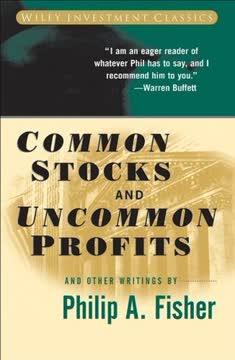
Most investment books begin with a promise. They offer a formula, a system, a set of rules that, if followed carefully, will produce predictable returns. Philip Fisher's book does something different. It begins with an observation: the most successful investments in history were not made by people who mastered formulas. They were made by people who understood businesses deeply, who had the patience to wait for extraordinary opportunities, and who had the courage to act decisively when those opportunities appeared. Fisher wrote Common Stocks and Uncommon Profits in an era when the investment world was dominated by two schools of thought. The first, rooted in the work of Benjamin Graham, focused on buying stocks that were statistically cheap relative to their assets and earnings. The second, practiced by most Wall Street professionals, involved attempting to predict short-term market movements and trading accordingly. Fisher proposed a third path. He argued that the greatest returns come from identifying exceptional companies early in their growth trajectories and holding them for many years, allowing the power of compounding to work its magic. What made Fisher's approach revolutionary was not just the emphasis on long-term holding. It was the method he developed for identifying exceptional companies in the first place. Instead of starting with financial statements, Fisher started with people. He wanted to know whether a company's management had vision, integrity, and the ability to execute. He wanted to understand whether the company's products were truly superior or merely adequate. He wanted to determine whether the business had the capacity to grow for decades, not just for the next few quarters. Fisher called his research method the scuttlebutt approach, borrowing a term from the business world that referred to the informal exchange of information. He would talk to competitors, suppliers, customers, former employees,…
Continue reading in the MinuteRead app
Get the complete 30-minute summary of Common Stocks and Uncommon Profits and Other Writings
Get the complete summary in the appInvest in exceptional companies with visionary management and sustainable growth potential.
Use the scuttlebutt method to gather information from competitors, suppliers, customers, and former employees.
Focus on long-term growth rather than short-term profits.
Profit margins reveal competitive strength. Look for companies that maintain above-average margins.
Research and development effectiveness matters more than R&D spending.
Management quality is the single most important factor in long-term success.
"Common Stocks and Uncommon Profits and Other Writings" is a strong fit if you want practical ideas around finance, business, economics, especially themes like invest in exceptional companies with visionary management and sustainable growth potential; use the scuttlebutt method to gather information from competitors, suppliers, customers, and former employees. The MinuteRead summary distills these concepts into a focused read, whether you're deciding whether to buy the book or applying its lessons at work.
Philip Arthur Fisher was a renowned American stock investor and author. His seminal work, Common Stocks and Uncommon Profits, published in 1958, has remained in print and is considered a classic in investment literature. Fisher began his career in 1928, leaving Stanford Graduate School of Business to work as a securities analyst. He later returned to Stanford as one of only three people to teach the investment course. Fisher's "Fifteen Points to Look for in a Common Stock" became a qualitative g…
View all summaries by Philip A. FisherContinue Reading
Access the complete 30-minute summary and thousands more nonfiction books in the MinuteRead app.

Continue reading the complete summary in the MinuteRead app.