MinuteRead
30 min
Book summary
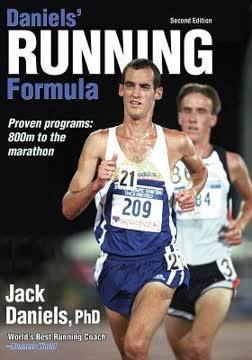
by Jack Daniels
Premium summary · Opens in the app · 30 min read
Most runners train by feel. They run hard when they feel good, easy when they feel tired, and hope that somehow the accumulation of miles will produce faster race times. Sometimes it works. Often it does not. The problem is not a lack of effort. The problem is a lack of direction.
**Author:** Jack Daniels
**Estimated Reading Time:** 45 minutes
**What You'll Learn:**
- The physiological systems that power distance running and how to train each one - The VDOT system for determining your exact training paces - How to structure training phases for peak performance - The principles behind safe mileage progression - Mental strategies for racing and training - Recovery protocols that prevent overtraining
**Who This Book Is For:**
This book is for runners who want to move beyond guesswork. Whether you are training for your first 5K or your twentieth marathon, whether you coach high school athletes or simply want to understand why some workouts work and others fail, this book provides a scientific framework that has stood the test of time. It is for anyone who has ever wondered if they are running too fast on easy days, too slow on hard days, or simply spinning their wheels without a plan.
Most runners train by feel. They run hard when they feel good, easy when they feel tired, and hope that somehow the accumulation of miles will produce faster race times. Sometimes it works. Often it does not. The problem is not a lack of effort. The problem is a lack of direction. Jack Daniels spent over five decades studying the science of distance running. He earned a Ph.D. in exercise physiology, won Olympic medals in modern pentathlon, and coached some of the finest distance runners in American history. Along the way, he noticed something that bothered him deeply. Runners were training with tremendous dedication but without a clear understanding of what their workouts were actually doing to their bodies. The result was predictable. Some runners trained too hard on easy days, leaving them too fatigued to perform well on hard days. Others trained too easy on hard days, never stimulating the adaptations that produce faster racing. Many got injured. Many burned out. Most never reached their potential. Daniels set out to solve this problem by creating a system. The system begins with a simple premise: every workout should have a purpose. Every mile you run should be doing something specific to make you a better runner. When you understand the purpose behind each type of training, you can structure your week, your month, and your season with confidence. The foundation of this system is the VDOT table. VDOT is a number that represents your current fitness level based on a recent race performance. Once you know your VDOT, you can look up the exact pace you should run for every type of workout: easy runs, threshold runs, interval sessions, and repetitions. No more guessing. No more running with the fast group on easy days because you are…
Continue reading in the MinuteRead app
Get the complete 30-minute summary of Daniels' Running Formula
Get the complete summary in the appEvery workout must have a purpose. Know what you are trying to accomplish before you start.
Easy running should make up about 80 percent of your total training volume.
Use the VDOT system to determine your training paces based on a recent race performance.
Threshold pace is the pace you could sustain for about an hour. Train at this pace to improve lactate clearance.
Interval pace is the pace you could sustain for 10 to 15 minutes. Train at this pace to improve VO2max.
Repetition pace is faster than interval pace. Train at this pace to improve speed and running economy.
"Daniels' Running Formula" is a strong fit if you want practical ideas around health & fitness, sports, fitness, especially themes like every workout must have a purpose. know what you are trying to accomplish before you start; easy running should make up about 80 percent of your total training volume. The MinuteRead summary distills these concepts into a focused read, whether you're deciding whether to buy the book or applying its lessons at work.
Jack Daniels is a renowned running coach and former Olympic medalist in modern pentathlon. He holds a Ph.D. in exercise physiology and has spent over 50 years in the sport of running. Daniels has coached numerous elite athletes and Olympians, developing a reputation as one of America's top distance running coaches. He is best known for creating the VDOT system, a method for determining optimal training paces based on current fitness levels. Jack Daniels has authored multiple books on running and…
View all summaries by Jack DanielsContinue Reading
Access the complete 30-minute summary and thousands more nonfiction books in the MinuteRead app.

Continue reading the complete summary in the MinuteRead app.