MinuteRead
30 min
Book summary
Premium summary · Opens in the app · 30 min read
Something has gone wrong in the examining room. The average doctor's appointment in the United States now lasts between seven and twelve minutes. In that brief window, a physician is expected to listen to a patient's story, review their history, perform an examination, arrive at a diagnosis, explain it clearly, and develop a treatment plan. The patient, meanwhile, has often waited weeks for this appointment and may have rehearsed what they wanted to say, only to find themselves interrupted withi
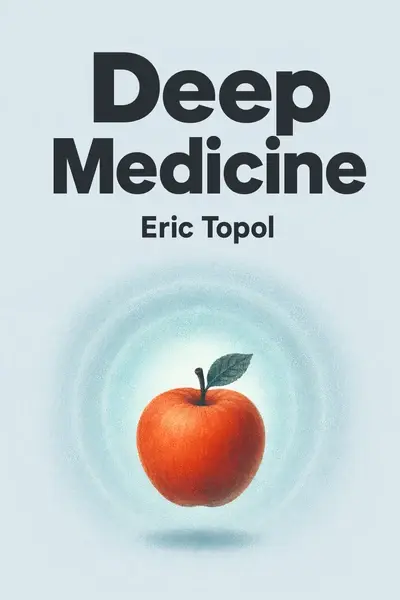
**Author:** Eric J. Topol **Estimated Reading Time:** 42 minutes
**What You'll Learn:**
Why modern medicine has lost its human core, how artificial intelligence is quietly transforming every corner of healthcare, and what a future built on the partnership between human empathy and machine intelligence could look like. You will understand the forces driving misdiagnosis and physician burnout, the breakthroughs in medical imaging, drug discovery, and personalized nutrition, and the concrete steps needed to build a deeper, more humane medical system.
**Who This Book Is For:**
Anyone who has ever felt rushed through a doctor's appointment, wondered whether their diagnosis was correct, or sensed that something essential has been lost in modern healthcare. This book is for patients, physicians, healthcare leaders, technologists, and anyone curious about how artificial intelligence might help restore the most ancient part of medicine: the relationship between a healer and a person in need.
Something has gone wrong in the examining room. The average doctor's appointment in the United States now lasts between seven and twelve minutes. In that brief window, a physician is expected to listen to a patient's story, review their history, perform an examination, arrive at a diagnosis, explain it clearly, and develop a treatment plan. The patient, meanwhile, has often waited weeks for this appointment and may have rehearsed what they wanted to say, only to find themselves interrupted within seconds of beginning to speak. This is not a failure of individual doctors. It is a structural failure of a system that has prioritized volume over depth, efficiency over understanding, and documentation over presence. Physicians spend nearly twice as much time entering data into electronic health records as they do interacting with patients. Many describe their work as data entry with occasional interruptions for medicine. Burnout rates among doctors now exceed fifty percent in many specialties. Depression and suicide rates among physicians are among the highest of any profession. Meanwhile, patients feel the consequences. Misdiagnosis affects an estimated twelve million Americans every year. Medical errors rank among the leading causes of death. Patients routinely report feeling unheard, unseen, and reduced to a collection of symptoms and lab values. The physician-patient relationship, once the cornerstone of healing, has been eroded by administrative burden, time pressure, and the digitization of medicine without thoughtful design. Eric Topol, a cardiologist and one of the most influential voices in digital medicine, believes this moment of crisis is also a moment of extraordinary opportunity. The same technologies that have contributed to medicine's depersonalization could, if deployed differently, restore its humanity. Artificial intelligence, machine learning, deep neural networks, and the explosion of personal health data offer a path toward what Topol calls deep medicine: a practice where technology handles the…
Continue reading in the MinuteRead app
Get the complete 30-minute summary of Deep Medicine
Get the complete summary in the appModern medicine is shallow: rushed visits, high misdiagnosis rates, and burned-out doctors.
Deep learning is transforming medical imaging, matching or exceeding human experts in specific tasks.
AI extends beyond imaging to surgery, mental health, drug discovery, and daily health management.
People respond very differently to the same foods; personalized nutrition is the future.
Virtual medical assistants can provide continuous support and empower individuals to manage their health.
Empathy and human connection are irreplaceable and improve outcomes.
"Deep Medicine" is a strong fit if you want practical ideas around health & fitness, science, medicine, especially themes like modern medicine is shallow: rushed visits, high misdiagnosis rates, and burned-out doctors; deep learning is transforming medical imaging, matching or exceeding human experts in specific tasks. The MinuteRead summary distills these concepts into a focused read, whether you're deciding whether to buy the book or applying its lessons at work.
Eric J. Topol is a renowned cardiologist, geneticist, and digital medicine researcher. He is the founder and director of the Scripps Research Translational Institute and a professor of molecular medicine at Scripps Research. Topol is known for his work in personalized medicine and the use of genomic and digital technologies in healthcare. He has authored several influential books on the future of medicine and technology, including "The Patient Will See You Now" and "The Creative Destruction of M…
View all summaries by Eric J. TopolContinue Reading
Access the complete 30-minute summary and thousands more nonfiction books in the MinuteRead app.

Continue reading the complete summary in the MinuteRead app.