MinuteRead
30 min
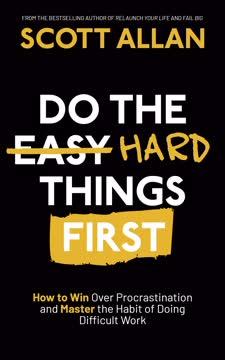
Book summary
by Scott Allan
Premium summary · Opens in the app · 30 min read
Every day, millions of people wake up with clear intentions. They plan to exercise, finish that report, start the business, write the book, or have the difficult conversation. They know exactly what needs to be done. And yet, hours later, they find themselves scrolling through social media, reorganizing their desk, or doing anything except the one task that matters most.
**Author:** Scott Allan
**Estimated Reading Time:** 45 minutes
**What You'll Learn:** - Why procrastination is a learned habit, not a fixed personality trait - How to identify and overcome the fears that drive avoidance - Practical systems for breaking overwhelming tasks into manageable steps - How to design your environment for focus and productivity - Strategies for building lasting accountability and self-discipline
**Who This Book Is For:** Anyone who has ever felt stuck in a cycle of delay, avoidance, and self-criticism. If you find yourself putting off important work, struggling to start difficult projects, or feeling frustrated by your own inaction, this book offers a practical path forward. It is for people who want to stop fighting themselves and start making meaningful progress.
Every day, millions of people wake up with clear intentions. They plan to exercise, finish that report, start the business, write the book, or have the difficult conversation. They know exactly what needs to be done. And yet, hours later, they find themselves scrolling through social media, reorganizing their desk, or doing anything except the one task that matters most. This is not a time management problem. It is not a laziness problem. It is a habit problem. Scott Allan wrote this book because he recognized a fundamental truth that most productivity advice misses: the hardest tasks are the ones that create the most value, and they are also the ones we are most likely to avoid. The solution is not to find more time or to work harder. The solution is to train yourself to do the hard things first. The problem is that most people have spent years, sometimes decades, conditioning themselves to avoid discomfort. When faced with a challenging task, the brain instinctively seeks escape. This is not a character flaw. It is a learned response. And like any learned response, it can be unlearned. Think about how you learned to procrastinate. As a child, you probably discovered that putting off homework felt better in the moment than doing it. You learned that avoiding a difficult conversation delayed the discomfort. You found that distractions provided immediate relief from anxiety. Each time you chose avoidance, you strengthened a neural pathway. Over time, that pathway became a highway. The good news is that the brain is remarkably plastic. It can change. New pathways can be built. New habits can be formed. But this requires more than willpower. It requires a systematic approach to understanding why you avoid, what triggers your procrastination, and how to replace avoidance patterns with action patterns. This book is different from typical productivity advice because it addresses the root cause of procrastination rather than just the symptoms. It does not simply tell…
Continue reading in the MinuteRead app
Get the complete 30-minute summary of Do the Hard Things First
Get the complete summary in the appProcrastination is a learned habit, not a personality trait. You can change it.
Fear is a compass. It points toward what matters. Lean into it.
Start before you feel ready. Motivation follows action.
Break tasks into small, specific, manageable steps.
Single-task. Multitasking is a myth that reduces productivity.
Design your environment to support your goals.
"Do the Hard Things First" is a strong fit if you want practical ideas around self help, productivity, business, especially themes like procrastination is a learned habit, not a personality trait. you can change it; fear is a compass. it points toward what matters. lean into it. The MinuteRead summary distills these concepts into a focused read, whether you're deciding whether to buy the book or applying its lessons at work.
Scott Allan is a prolific author in the self-help and personal development genre, having published over 15 books. His work focuses on topics such as overcoming procrastination, building self-discipline, and improving productivity. Allan draws from his own life experiences to provide practical advice and strategies for readers. While some reviewers note his lack of formal psychological credentials, many appreciate his accessible writing style and relatable examples. Allan's books often incorporat…
View all summaries by Scott AllanContinue Reading
Access the complete 30-minute summary and thousands more nonfiction books in the MinuteRead app.

Continue reading the complete summary in the MinuteRead app.