MinuteRead
30 min
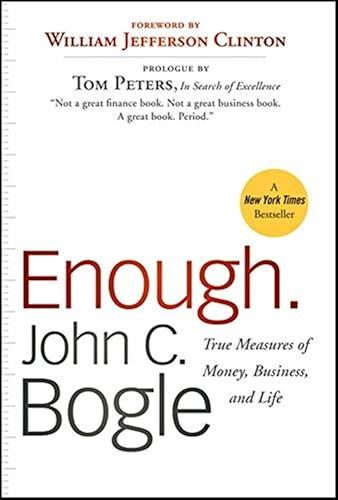
In 1974, John C. Bogle made a decision that most of his peers considered professional suicide. He had just been fired from his position as chairman of Wellington Management Company, the firm he had helped build into one of the most respected money managers in America. The conventional response would have been to start another traditional investment firm, charge the standard fees, and continue playing the game by its established rules.
**Author:** John C. Bogle
**Estimated Reading Time:** 45 minutes
**What You'll Learn:**
- Why the financial system, despite its enormous size, often subtracts value from society rather than adding it - How the relentless arithmetic of costs determines what investors actually earn - The critical difference between investing and speculating, and why most of Wall Street has lost sight of it - Why simplicity beats complexity in nearly every financial decision - How the erosion of professional values has transformed money management from a calling into a business - What true leadership looks like when measured against character rather than quarterly results - How to define "enough" in a culture that constantly demands more
**Who This Book Is For:**
This book is for anyone who suspects that our financial system has lost its way. It is for investors who feel overwhelmed by complexity and wonder if there is a simpler path. It is for professionals who sense that something essential has been lost in the relentless pursuit of profit. And it is for every reader who has ever paused to ask whether the life they are building is measured by the right things.
In 1974, John C. Bogle made a decision that most of his peers considered professional suicide. He had just been fired from his position as chairman of Wellington Management Company, the firm he had helped build into one of the most respected money managers in America. The conventional response would have been to start another traditional investment firm, charge the standard fees, and continue playing the game by its established rules. Instead, Bogle did something radical. He founded a company structured to be owned by its fund shareholders rather than by outside investors. He created the first index mutual fund available to individual investors, a product that Wall Street ridiculed as "Bogle's Folly." And he built an organization around a simple, almost heretical idea: that the interests of the financial services industry and the interests of its clients are fundamentally opposed. The industry exists to gather assets and extract fees. Investors need those same assets to grow. Every dollar that goes to the financial intermediary is a dollar that does not compound for the person saving for retirement, for a child's education, for a home. This is not a matter of opinion or ideology. It is arithmetic. Bogle spent the next four decades proving this point. Vanguard grew from a struggling upstart with $11 million in assets to one of the largest investment companies in the world, managing trillions of dollars. The index fund went from being dismissed as un-American to being recognized as the most reliable way for ordinary people to capture the returns of the…
Continue reading in the MinuteRead app
Get the complete 30-minute summary of Enough
Get the complete summary in the appThe gross return of the market minus the costs of the system equals the net return to investors. Costs are the enemy of
Low-cost index funds allow investors to capture nearly all of the market's return by minimizing costs.
Investing is the long-term ownership of businesses. Speculation is short-term trading based on price predictions. Invest
Simplicity beats complexity. The simplest investing strategy is also the most effective.
The financial industry has transformed from stewardship to salesmanship, from serving investors to gathering assets.
Management is about doing things right. Leadership is about doing the right things. Organizations need both.
"Enough" is a strong fit if you want practical ideas around finance, business, economics, especially themes like the gross return of the market minus the costs of the system equals the net return to investors. costs are the enemy of; low-cost index funds allow investors to capture nearly all of the market's return by minimizing costs. The MinuteRead summary distills these concepts into a focused read, whether you're deciding whether to buy the book or applying its lessons at work.
Motivated to help readers with on balance, John C. Bogle wrote “Enough” to package those ideas for a fast, focused read. In “Enough”, John C. Bogle focuses on on balance. Through “Enough”, John C. Bogle distills the core ideas on finance into lessons readers can absorb in a single short sitting. Readers turn to this work when they want John C. Bogle's perspective on the subject without working through the entire original volume. John Clifton "Jack" Bogle (May 8, 1929 – January 16, 2019) was an A…
View all summaries by John C. BogleContinue Reading
Access the complete 30-minute summary and thousands more nonfiction books in the MinuteRead app.

Continue reading the complete summary in the MinuteRead app.