MinuteRead
30 min
Book summary
Premium summary · Opens in the app · 30 min read
Most people believe they are ethical. They would never steal a car, embezzle from an employer, or deliberately harm an innocent person. Yet ethical failure surrounds us. Respected executives go to prison. Trusted advisors betray their clients. Loving spouses destroy their marriages. Good people do bad things, and afterward they often cannot explain how it happened.
**Author:** Ronald A. Howard **Estimated Reading Time:** 48 minutes
**What You'll Learn**
You will learn why ethical failure is rarely a single catastrophic choice but almost always a series of small compromises that seemed reasonable at the time. You will learn to recognize the everyday temptations that pull good people off course. You will learn a clear framework for distinguishing between what is legal, what is prudent, and what is right. Most importantly, you will learn to build a personal ethical code that makes wise choices easier in the moment, and you will discover how to transform ethical challenges into opportunities for deeper relationships and a more meaningful life.
**Who This Book Is For**
This book is for anyone who has ever looked back on a decision and wondered how they ended up somewhere they never intended to go. It is for professionals who sense that legal compliance is not the same as integrity. It is for people who want to navigate gray areas without losing their moral bearings. It is for those who suspect that ethical skill is not something you are born with but something you can develop, practice, and master.
Most people believe they are ethical. They would never steal a car, embezzle from an employer, or deliberately harm an innocent person. Yet ethical failure surrounds us. Respected executives go to prison. Trusted advisors betray their clients. Loving spouses destroy their marriages. Good people do bad things, and afterward they often cannot explain how it happened. The uncomfortable truth is that ethical disaster rarely announces itself. It does not arrive as a dramatic temptation between obvious right and obvious wrong. It arrives in small moments. A slight exaggeration on a resume that no one will check. A convenient omission in a conversation that avoids conflict. A minor bending of a rule because everyone else does it. A small harm justified by a larger good. Each step feels reasonable. Each step seems insignificant. But step by step, a person who would never commit a major ethical violation finds themselves living a life built on compromises they once would have condemned. Ronald Howard wrote this book because he recognized a gap in how we think about ethics. Most ethical education focuses on big philosophical questions or dramatic case studies of catastrophic failure. But most ethical problems are not dramatic. They are ordinary. They happen in meetings, in conversations, in expense reports, in moments when telling the full truth would cost something. The real challenge of ethics is not knowing what is right in extreme situations. It is having the clarity and the courage to do what is right in the small moments that accumulate into a life. Howard's approach…
Continue reading in the MinuteRead app
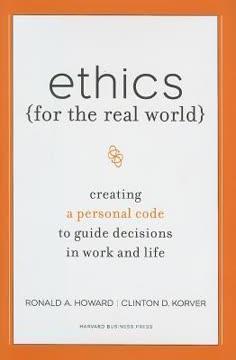
Get the complete 30-minute summary of Ethics for the Real World
Get the complete summary in the appEthical decision-making is a skill you can learn and improve, not a fixed trait you either have or lack.
Small ethical compromises are dangerous because each one makes the next one easier, gradually reshaping your character.
Always separate prudential, legal, and ethical questions. What benefits you, what the law allows, and what is right are
Rationalization starts with a desired conclusion and works backward. Reasoning starts with a genuine question and follow
Build a personal ethical code with specific commitments about lying, stealing, and harming. Commit in advance, before yo
Use a systematic process for ethical decisions: clarify the issue, create alternatives, evaluate against your principles
"Ethics for the Real World" is a strong fit if you want practical ideas around business, philosophy, self help, especially themes like ethical decision-making is a skill you can learn and improve, not a fixed trait you either have or lack; small ethical compromises are dangerous because each one makes the next one easier, gradually reshaping your character. The MinuteRead summary distills these concepts into a focused read, whether you're deciding whether to buy the book or applying its lessons at work.
Ronald A. Howard is a respected author and educator in the field of ethics and decision analysis. He is known for his practical approach to ethical decision-making, focusing on real-world applications rather than abstract philosophical concepts. Howard has authored several books on ethics and decision-making, with "Ethics for the Real World" being one of his most notable works. He is recognized for his ability to present complex ethical concepts in an accessible manner, making his work valuable …
View all summaries by Ronald A. HowardContinue Reading
Access the complete 30-minute summary and thousands more nonfiction books in the MinuteRead app.

Continue reading the complete summary in the MinuteRead app.