MinuteRead
30 min
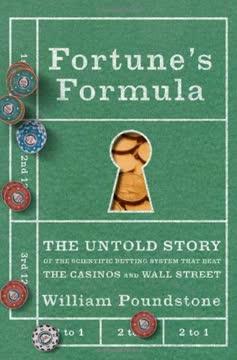
In the summer of 1956, a physicist at Bell Labs named John Kelly Jr. published a short paper with an unassuming title: "A New Interpretation of Information Rate." The paper was about telecommunications, or so it seemed. Kelly was analyzing the problem of how to transmit signals reliably over noisy telephone lines. But buried inside his equations was an idea that would eventually travel far beyond the world of telephony. It would find its way into blackjack, horse racing, hedge funds, and the hig
**Author:** William Poundstone
**Estimated Reading Time:** 45 minutes
**What You'll Learn:**
- How a mathematical formula originally designed for telephone lines became one of the most powerful tools in investing - The remarkable story of how scientists beat gamblers, casinos, and Wall Street - Why the Kelly criterion remains both celebrated and controversial decades after its discovery - What happens when brilliant people with flawless math still manage to lose billions - How information theory, probability, and human psychology intersect in the pursuit of wealth
**Who This Book Is For:**
This book is for anyone who wants to understand the hidden mathematical architecture beneath gambling, investing, and risk-taking. Whether you are an investor trying to size positions intelligently, a gambler curious about the science of advantage play, or simply a reader fascinated by the intersection of genius and money, this story will change how you think about uncertainty. No advanced mathematics is required, only a willingness to follow one of the most extraordinary intellectual adventures of the twentieth century.
In the summer of 1956, a physicist at Bell Labs named John Kelly Jr. published a short paper with an unassuming title: "A New Interpretation of Information Rate." The paper was about telecommunications, or so it seemed. Kelly was analyzing the problem of how to transmit signals reliably over noisy telephone lines. But buried inside his equations was an idea that would eventually travel far beyond the world of telephony. It would find its way into blackjack, horse racing, hedge funds, and the highest echelons of Wall Street. Kelly had discovered a formula that answered a deceptively simple question: when you have an edge, how much should you bet? The question sounds trivial. If you have an advantage, bet something. But how much? Bet too little and you leave money on the table. Bet too much and you risk ruin. The difference between these two errors is not merely academic. It is the difference between building lasting wealth and losing everything. Kelly's answer was elegant and counterintuitive. He showed that there is an optimal bet size, a precise fraction of your bankroll that maximizes the long-term growth of your wealth. Bet more than this amount and your wealth will eventually decline, even if you have a genuine edge. Bet less and your wealth will grow, but more slowly than it could. The formula became known as the Kelly criterion, and it would become one of the most influential and controversial ideas in the history of finance. This book tells the story of that formula and the remarkable people who discovered, applied, and sometimes ignored it. It is a story that begins with Claude Shannon, the quiet genius who invented information theory…
Continue reading in the MinuteRead app
Get the complete 30-minute summary of Fortune's Formula
Get the complete summary in the appThe Kelly criterion tells you the optimal fraction of your bankroll to bet to maximize long-term wealth growth: f = (bp
Betting more than the Kelly amount increases your risk of ruin without increasing your long-term growth rate.
Overestimating your edge is the most common and dangerous mistake. Use fractional Kelly to account for uncertainty.
Edward Thorp proved that mathematical analysis could beat blackjack and the stock market.
The Efficient Market Hypothesis is mostly true but not perfectly true. Skill can produce superior returns.
Statistical arbitrage exploits small, fleeting inefficiencies using mathematical models and computing power.
"Fortune's Formula" is a strong fit if you want practical ideas around finance, business, economics, especially themes like the kelly criterion tells you the optimal fraction of your bankroll to bet to maximize long-term wealth growth: f = (bp; betting more than the kelly amount increases your risk of ruin without increasing your long-term growth rate. The MinuteRead summary distills these concepts into a focused read, whether you're deciding whether to buy the book or applying its lessons at work.
William Poundstone is an accomplished non-fiction author with over ten books to his name. His work "Fortune's Formula" gained significant recognition, becoming Amazon Editors' #1 non-fiction pick in 2005. Poundstone's writing has appeared in prestigious publications like The New York Times and Harvard Business Review. He has also made numerous media appearances, including on the Today Show. With a background in physics from MIT, Poundstone often explores the societal and financial implications o…
View all summaries by William PoundstoneContinue Reading
Access the complete 30-minute summary and thousands more nonfiction books in the MinuteRead app.

Continue reading the complete summary in the MinuteRead app.