MinuteRead
30 min
Book summary
Premium summary · Opens in the app · 30 min read
Imagine living with a mind that constantly asks, "But what if?" What if I left the stove on and the house burns down? What if I touched something contaminated and now someone will get sick? What if I said something offensive and don't remember? What if I'm a terrible person and just don't know it yet?
**Author:** Jonathan Grayson
**Estimated Reading Time:** 45 minutes
**What You'll Learn:** Why uncertainty lies at the heart of OCD, how obsessions and compulsions form a self-reinforcing cycle, and how to design a personalized recovery program using exposure and response prevention therapy.
**Who This Book Is For:** Anyone living with OCD, loved ones seeking to understand the disorder, and clinicians looking for a compassionate yet rigorous treatment framework.
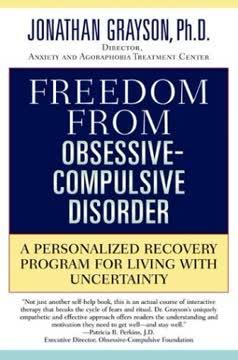
Imagine living with a mind that constantly asks, "But what if?" What if I left the stove on and the house burns down? What if I touched something contaminated and now someone will get sick? What if I said something offensive and don't remember? What if I'm a terrible person and just don't know it yet? For most people, these thoughts flicker through consciousness and disappear. They are recognized as improbable, dismissed as noise, or simply accepted as part of being human. But for someone with obsessive-compulsive disorder, these thoughts do not pass. They stick. They demand attention. They insist on an answer. And here is the cruel paradox: the more desperately a person seeks certainty, the more elusive it becomes. The more they check, the less sure they feel. The more they wash, the more contaminated they believe themselves to be. The more they seek reassurance, the more doubt grows. Jonathan Grayson has spent decades working with people trapped in this cycle. His book, *Freedom From Obsessive-Compulsive Disorder*, is not a collection of quick tips or superficial advice. It is a comprehensive treatment manual, a philosophical exploration of uncertainty, and a compassionate guide for anyone who has felt imprisoned by their own mind. The central premise of Grayson's work is both simple and profound: OCD is not fundamentally about germs, locks, symmetry, or intrusive thoughts. It is about the inability to tolerate uncertainty. The specific content of obsessions varies endlessly, but the underlying mechanism remains constant. The sufferer demands absolute certainty in a world that offers none. This insight changes everything about how we understand and treat the disorder. If OCD were really about germs, then washing would be a rational response. If it were really about safety, then checking would make sense. But because OCD is about the demand for certainty, the solution is not more washing or checking. The solution is learning to live with uncertainty. Grayson's approach is grounded in cognitive behavioral therapy, specifically exposure and response prevention, widely considered the gold standard treatment for OCD. But what sets his work apart is the depth of his understanding and the practicality of his guidance. He does not simply tell readers to "face their fears." He shows them how to identify their specific feared consequences, design graduated exposure exercises, and…
Continue reading in the MinuteRead app
Get the complete 30-minute summary of Freedom From Obsessive-Compulsive Disorder
Get the complete summary in the appUncertainty is the root of OCD. The demand for certainty fuels anxiety and drives compulsions.
Certainty is impossible. No amount of checking, washing, or reassurance will ever provide it.
OCD is a genuine disorder, not a character flaw. It has biological and psychological roots.
The obsessive-compulsive cycle is self-reinforcing. Compulsions provide temporary relief but maintain the disorder.
Exposure and response prevention is the core treatment. Confront fears without performing compulsions.
The goal is not to eliminate anxiety, but to learn that anxiety is bearable and will pass.
"Freedom From Obsessive-Compulsive Disorder" is a strong fit if you want practical ideas around health & fitness, psychology, mental health, especially themes like uncertainty is the root of ocd. the demand for certainty fuels anxiety and drives compulsions; certainty is impossible. no amount of checking, washing, or reassurance will ever provide it. The MinuteRead summary distills these concepts into a focused read, whether you're deciding whether to buy the book or applying its lessons at work.
Jonathan Grayson is a renowned expert in the treatment of Obsessive-Compulsive Disorder (OCD). As a psychologist, he has dedicated his career to helping individuals overcome OCD through evidence-based methods, particularly exposure and response prevention therapy. Grayson's approach emphasizes living with uncertainty and abandoning ritualistic behaviors. His work is characterized by clear, compassionate explanations and practical strategies for both sufferers and therapists. Grayson's expertise …
View all summaries by Jonathan GraysonContinue Reading
Access the complete 30-minute summary and thousands more nonfiction books in the MinuteRead app.

Continue reading the complete summary in the MinuteRead app.