MinuteRead
30 min
In May 1940, as German tanks rolled through France, the United States Army ranked seventeenth in the world in size, just behind Romania. The American military possessed fewer than 500 tanks, most of them obsolete. The Army Air Corps flew planes that were outclassed by both German and Japanese aircraft. The Navy, while respectable, was spread thin across two oceans. America had the eighteenth largest army on earth, a force smaller than Portugal's.
**Author:** Arthur Herman
**Estimated Reading Time:** 45 minutes
**What You'll Learn:**
How American business leaders transformed a peacetime economy into the greatest industrial war machine in history, the specific methods they used to achieve unprecedented production levels, and why this story remains relevant for anyone facing large-scale organizational challenges today.
**Who This Book Is For:**
Readers interested in World War II history, business leaders seeking lessons in rapid scaling and innovation, students of American economic history, and anyone curious about how ordinary organizations achieve extraordinary results under pressure.
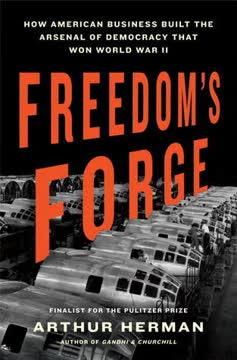
In May 1940, as German tanks rolled through France, the United States Army ranked seventeenth in the world in size, just behind Romania. The American military possessed fewer than 500 tanks, most of them obsolete. The Army Air Corps flew planes that were outclassed by both German and Japanese aircraft. The Navy, while respectable, was spread thin across two oceans. America had the eighteenth largest army on earth, a force smaller than Portugal's. Yet less than five years later, the United States was producing more war materiel than every other nation on earth combined. American factories turned out ships, planes, tanks, and guns at a rate that stunned both allies and enemies. By 1944, the United States was launching a new aircraft carrier every month, building a B-24 bomber every sixty-three minutes, and producing enough ammunition to supply not only American forces but also British, Soviet, and other Allied armies fighting on multiple continents. How did this happen? The answer is not found in government planning or military genius alone. The answer lies in the story of American business leaders, engineers, and workers who accomplished what many believed impossible. They converted automobile plants into aircraft factories. They built shipyards from scratch in weeks. They solved production problems that had stumped experts for years. They did it through a combination of practical knowledge, competitive drive, and a willingness to try new approaches. Arthur Herman's *Freedom's Forge* tells this story through the lives of the men who made it happen. William Knudsen, the Danish immigrant who rose to lead General Motors and then directed America's industrial mobilization. Henry Kaiser, the construction magnate who revolutionized shipbuilding. Donald Nelson, the Sears executive who managed the complex web of wartime production priorities. And dozens of other industrialists, engineers, and managers who brought their civilian expertise to the task of arming a nation. The book challenges a common assumption about World War II: that government planning and control were responsible for the Allied victory. Herman argues the opposite. The American achievement was possible precisely because the government partnered with private industry rather than nationalizing it. The men who ran the war production effort were not bureaucrats or generals.…
Continue reading in the MinuteRead app
Get the complete 30-minute summary of Freedom's Forge
Get the complete summary in the appAmerica won World War II through industrial production, out-producing all Axis powers combined by 1943.
William Knudsen, a Danish immigrant who rose to lead General Motors, directed America's industrial mobilization.
Mass production is about accuracy and standardization, not just speed.
Henry Kaiser revolutionized shipbuilding by challenging conventional wisdom and applying construction techniques to ship
The automotive industry converted to war production and produced 80 percent of all tanks and 100 percent of all Army tru
The B-24 bomber was mass-produced on an assembly line at a rate of one every sixty-three minutes.
"Freedom's Forge" is a strong fit if you want practical ideas around history, business, economics, especially themes like america won world war ii through industrial production, out-producing all axis powers combined by 1943; william knudsen, a danish immigrant who rose to lead general motors, directed america's industrial mobilization. The MinuteRead summary distills these concepts into a focused read, whether you're deciding whether to buy the book or applying its lessons at work.
Arthur L. Herman is an American historian and senior fellow at the Hudson Institute. Born in 1956, he is known for his popular historical works that often employ the Great Man perspective, a 19th-century methodology attributing historical events to the actions of influential individuals. This approach has been refined by modern thinkers like Sidney Hook. Herman's writing style and choice of subjects reflect his conservative intellectual background, having associations with think tanks such as th…
View all summaries by Arthur HermanContinue Reading
Access the complete 30-minute summary and thousands more nonfiction books in the MinuteRead app.

Continue reading the complete summary in the MinuteRead app.