MinuteRead
30 min
Book summary
by Matt Stoller
Premium summary · Opens in the app · 30 min read
There is a story Americans tell themselves about their economy. It is a story of natural progress, of markets finding their equilibrium, of innovation disrupting the old and ushering in the new. In this story, government intervention is at best a necessary evil and at worst a hindrance to prosperity. The story suggests that whatever exists today exists because it is efficient, because it won, because it deserved to win.
**Author:** Matt Stoller
**Estimated Reading Time:** 45 minutes
**What You'll Learn:**
- How monopoly power has shaped American politics for over a century - Why the fight against concentrated economic power defined democracy - The rise and fall of antitrust enforcement in the United States - How the Chicago School of economics quietly dismantled New Deal protections - Why the battle between democracy and monopoly is far from over
**Who This Book Is For:**
This book is for anyone who senses that something has gone wrong with the American economy but cannot quite articulate what. It is for citizens puzzled by rising inequality, disappearing small businesses, and the immense power of a handful of corporations. It is for readers who want to understand why their economic choices feel constrained, why their communities have lost local institutions, and why politics seems unresponsive to ordinary people. Most of all, it is for those who suspect that the concentration of wealth and power is not an accident but a choice, and who want to understand the history behind that choice.
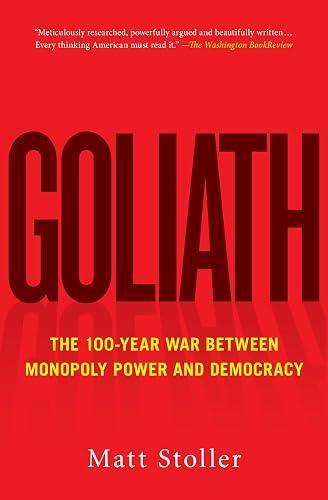
There is a story Americans tell themselves about their economy. It is a story of natural progress, of markets finding their equilibrium, of innovation disrupting the old and ushering in the new. In this story, government intervention is at best a necessary evil and at worst a hindrance to prosperity. The story suggests that whatever exists today exists because it is efficient, because it won, because it deserved to win. Matt Stoller's *Goliath* dismantles this story piece by piece. The book begins with a simple observation: American democracy has always been defined by a struggle between two opposing forces. On one side stands the democratic impulse, the belief that power should be distributed widely, that citizens should have control over their economic lives, and that concentrated authority threatens liberty. On the other side stands the monopolistic impulse, the drive to consolidate power, eliminate competition, and extract wealth from the many for the benefit of the few. This struggle is not a recent development. It predates the American Revolution. It shaped the founding debates over banking and corporations. It erupted in the populist revolts of the late nineteenth century. It defined the Progressive Era, the New Deal, and the post-war consensus. And it is being waged again today, in battles over technology platforms, pharmaceutical pricing, and the power of financial institutions. What makes Stoller's account distinctive is his insistence that the outcomes of these battles were never inevitable. The dominance of a few massive corporations today is not the result of natural market forces. It is the result of specific policy choices, deliberate legal interpretations, and organized political campaigns. The men who built monopolies…
Continue reading in the MinuteRead app
Get the complete 30-minute summary of Goliath
Get the complete summary in the appMonopoly is a political problem, not merely an economic one. It threatens democracy itself.
The concentration of economic power inevitably leads to the concentration of political power.
The antimonopoly tradition is a defining feature of American history, from the populists to the New Dealers.
The post-war prosperity was the result of deliberate policy choices, including strong antitrust enforcement, support for
The Chicago School dismantled the antimonopoly tradition by redefining antitrust to focus narrowly on consumer welfare.
The dismantling of the New Deal was a political project driven by wealthy interests, not a necessary response to economi
"Goliath" is a strong fit if you want practical ideas around history, economics, politics, especially themes like monopoly is a political problem, not merely an economic one. it threatens democracy itself; the concentration of economic power inevitably leads to the concentration of political power. The MinuteRead summary distills these concepts into a focused read, whether you're deciding whether to buy the book or applying its lessons at work.
Motivated to help readers with "To have failed to solve the problem of producing goods would have been to continue man in his oldest and, Matt Stoller wrote “Goliath” to package those ideas for a fast, focused read. In “Goliath”, Matt Stoller focuses on "To have failed to solve the problem of producing goods would have been to continue man in his oldest and. Through “Goliath”, Matt Stoller distills the core ideas on history into lessons readers can absorb in a single short sitting. Readers turn …
Continue Reading
Access the complete 30-minute summary and thousands more nonfiction books in the MinuteRead app.

Continue reading the complete summary in the MinuteRead app.