MinuteRead
30 min
Book summary
Premium summary · Opens in the app · 30 min read
Most traders lose money. This is not a controversial statement. It is a statistical reality that has persisted across decades and markets. The reasons are well documented: emotional decision-making, lack of a systematic approach, poor risk management, and an inability to distinguish between high and low probability trade setups.
**Estimated Reading Time:** 45 minutes
**What You'll Learn:**
- How to align multiple time frames to identify high probability trade setups - How to distinguish between trends and corrections using pattern recognition - How to apply dynamic price and time strategies for precise market timing - How to execute trades using objective entry rules that remove emotion - How to manage risk and position sizing to protect your capital - How to build a complete trading business with a written plan
**Who This Book Is For:**
This book is for traders who are tired of inconsistent results and emotional decision-making. Whether you trade stocks, futures, forex, or commodities, the principles in this book apply across all markets and time frames. If you have ever wondered why your entries are consistently early or late, why your stops get hit before the market moves in your direction, or why you exit winning trades too soon, this book provides the framework to address those challenges systematically.
Most traders lose money. This is not a controversial statement. It is a statistical reality that has persisted across decades and markets. The reasons are well documented: emotional decision-making, lack of a systematic approach, poor risk management, and an inability to distinguish between high and low probability trade setups. What is less well documented is why some traders consistently succeed while the majority struggle. Robert C. Miner spent years studying this question, and his conclusion is both simple and profound: successful traders do not predict the market. They identify conditions where the probability of a particular outcome is significantly higher than random, and they act only when those conditions are present. The problem with most trading education is that it focuses on isolated techniques. A trader learns about moving averages, Fibonacci retracements, candlestick patterns, or oscillators, and then tries to combine these tools without understanding how they fit together. The result is confusion, contradictory signals, and ultimately, losses. Miner's approach is different. He presents a complete, integrated methodology that answers four essential questions every trader must address before entering any trade: What is the direction of the larger trend? Where is the market likely to reverse? When is the reversal likely to occur? How should the trade be executed and managed? These questions form the backbone of the Multiple Time Frame Momentum Strategy, a comprehensive approach that combines trend analysis, pattern recognition, price projection, time analysis, and objective execution rules. The significance of this approach extends beyond any single market or time frame. The principles Miner describes apply equally to a day trader watching five-minute charts and a position trader analyzing weekly data. The underlying structure of markets, the patterns that emerge from crowd psychology, and the…
Continue reading in the MinuteRead app
Get the complete 30-minute summary of High Probability Trading Strategies
Get the complete summary in the appTrade in the direction of the larger time frame momentum; execute following a smaller time frame momentum reversal.
Trends consist of five waves without overlap; corrections involve overlapping waves.
Most reversals occur at or near key Fibonacci retracement levels: 38.2%, 50%, 61.8%, and 78.6%.
Time analysis is as important as price analysis. When time is up, change is inevitable.
Never enter a trade based on anticipation alone. Always wait for the market to confirm the reversal.
Risk no more than 3% of your account on any single trade and no more than 6% on all open trades combined.
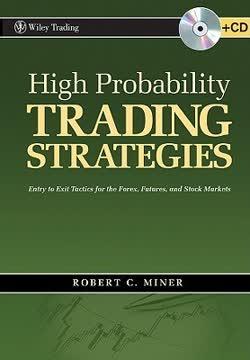
"High Probability Trading Strategies" is a strong fit if you want practical ideas around finance, business, economics, especially themes like trade in the direction of the larger time frame momentum; execute following a smaller time frame momentum reversal; trends consist of five waves without overlap; corrections involve overlapping waves. The MinuteRead summary distills these concepts into a focused read, whether you're deciding whether to buy the book or applying its lessons at work.
Robert C. Miner is a professor of philosophy at Baylor University and the author of "High Probability Trading Strategies." While his academic background is in philosophy, Miner has made a significant impact in the field of financial trading through his book. The work draws on his expertise to provide traders with strategies for analyzing markets and making informed decisions. Miner's approach combines technical analysis, pattern recognition, and market timing techniques. His book has gained reco…
View all summaries by Robert C. MinerContinue Reading
Access the complete 30-minute summary and thousands more nonfiction books in the MinuteRead app.

Continue reading the complete summary in the MinuteRead app.