MinuteRead
30 min
Book summary
Premium summary · Opens in the app · 30 min read
The young woman sat in the examining room, her face flushed with frustration. For fifteen years she had been told her symptoms were all in her head. She had seen psychiatrist after psychiatrist, taken medication after medication, and still she could not eat without pain, could not keep weight on her frame, could not live a normal life. Then one day, a gastroenterologist looked at her chart, looked at her, and said something no one else had said: "I don't think this is in your head. I think somet
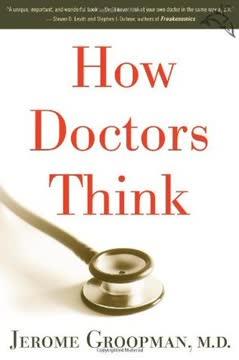
**Author:** Jerome Groopman **Estimated Reading Time:** 2 hours 45 minutes
**What You'll Learn:** - Why even brilliant doctors make diagnostic errors and how those errors happen - The hidden cognitive traps that distort medical judgment - How emotions, both the doctor's and the patient's, shape clinical decisions - What patients can do to help their doctors think more clearly - How to become a more effective partner in your own medical care
**Who This Book Is For:** Anyone who has ever felt confused, rushed, or unheard in a doctor's office. Anyone who has wondered whether their diagnosis was correct. Anyone who wants to understand how medical minds work, where they fail, and how to protect themselves and their loved ones from those failures. This book is for patients, families, and medical professionals who want to think more clearly about thinking itself.
The young woman sat in the examining room, her face flushed with frustration. For fifteen years she had been told her symptoms were all in her head. She had seen psychiatrist after psychiatrist, taken medication after medication, and still she could not eat without pain, could not keep weight on her frame, could not live a normal life. Then one day, a gastroenterologist looked at her chart, looked at her, and said something no one else had said: "I don't think this is in your head. I think something is physically wrong." He was right. She had celiac disease, an autoimmune condition that damages the small intestine when gluten is consumed. The diagnosis took fifteen years, not because the disease was exotic or the tests were unavailable, but because doctor after doctor had stopped thinking. They had anchored on a psychiatric explanation and never questioned it. Jerome Groopman has spent his career as a hematologist and oncologist at one of the world's leading medical centers. He has taught at Harvard Medical School, conducted groundbreaking research, and treated thousands of patients. But in this book, he turns his attention to a question that haunts medicine: Why do doctors get it wrong? The answer, he discovered, is not what most people expect. Medical errors are rarely caused by ignorance or technical incompetence. A doctor who misreads an X-ray or prescribes the wrong dose of medication has made a technical mistake, and those mistakes are relatively easy to identify and correct. But a doctor who misdiagnoses a patient has made a cognitive error. The problem lies not in what the doctor knows, but in how the doctor thinks. Groopman began investigating this question after watching colleagues, brilliant and dedicated physicians, make errors that seemed inexplicable. He interviewed dozens of doctors across specialties, from emergency room physicians to oncologists to pediatricians. He asked…
Continue reading in the MinuteRead app
Get the complete 30-minute summary of How Doctors Think
Get the complete summary in the app**Ask "What else could it be?"** This simple question interrupts anchoring and prompts doctors to consider alternatives.
**Tell your story fully.** The patient's story is the foundation of diagnosis. Don't omit information because you think
**Prepare for medical visits.** Write down your symptoms and bring a list of questions.
**Pay attention to emotional signals.** If you feel uneasy about a diagnosis, take that feeling seriously.
**Be wary of quick diagnoses.** If a diagnosis is made quickly or based on a single test, ask for more information.
**Ask about alternatives.** "Are there other conditions that could cause these symptoms?" "Is there anything that doesn'
"How Doctors Think" is a strong fit if you want practical ideas around health & fitness, medicine, medical, especially themes like **ask "what else could it be?"** this simple question interrupts anchoring and prompts doctors to consider alternatives; **tell your story fully.** the patient's story is the foundation of diagnosis. don't omit information because you think. The MinuteRead summary distills these concepts into a focused read, whether you're deciding whether to buy the book or applying its lessons at work.
Jerome E. Groopman, MD is a hematologist, oncologist, and chief of experimental medicine at Boston's Beth Israel Deaconess Medical Center. At 44, he began writing about patients' experiences, blending his medical expertise with compassionate storytelling. His book The Measure of Our Days received critical acclaim and inspired a TV drama. Groopman became a staff writer for The New Yorker in 1998, focusing on medicine and biology. His writing captures medical mysteries and human dramas, reflecting…
View all summaries by Jerome GroopmanContinue Reading
Access the complete 30-minute summary and thousands more nonfiction books in the MinuteRead app.

Continue reading the complete summary in the MinuteRead app.