MinuteRead
30 min
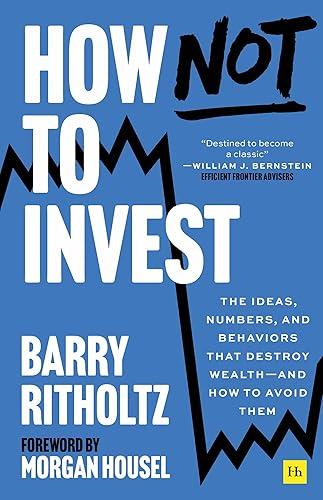
Book summary
by Barry Ritholtz
Premium summary · Opens in the app · 30 min read
Every day, millions of people make financial decisions based on predictions that will turn out to be wrong. They watch television pundits confidently explain where the market is heading. They read articles about which stocks to buy and which to avoid. They listen to friends, colleagues, and family members who seem certain about what comes next. And then they act on that information, often with disastrous results.
**Author:** Barry Ritholtz **Estimated Reading Time:** 45 minutes
**What You'll Learn:** - Why almost every financial forecast is worthless - How your brain sabotages your investment decisions - Why indexing beats stock picking for nearly everyone - How to build a plan that survives market chaos - Where the real risks to your wealth hide
**Who This Book Is For:** Anyone who has ever felt anxious about money, confused by financial news, tempted to act on a hot tip, or uncertain whether their investment strategy actually works. If you want to stop making costly mistakes and start building wealth with confidence, this book is for you.
Every day, millions of people make financial decisions based on predictions that will turn out to be wrong. They watch television pundits confidently explain where the market is heading. They read articles about which stocks to buy and which to avoid. They listen to friends, colleagues, and family members who seem certain about what comes next. And then they act on that information, often with disastrous results. The uncomfortable truth is that nobody knows what the market will do tomorrow, next month, or next year. Not the experts on television. Not the strategists at major banks. Not the Nobel laureates or the billionaires. The evidence is overwhelming: forecasting is a fool's game, and the people who pretend otherwise are usually selling something. Barry Ritholtz has spent decades watching this dynamic play out. As a financial advisor, market commentator, and student of behavioral economics, he has seen intelligent people destroy their wealth by trusting predictions, following conflicted advice, and letting emotions override reason. He has also seen ordinary investors achieve extraordinary results by doing the opposite: embracing humility, keeping costs low, diversifying broadly, and sticking to a plan. This book is not about getting rich quickly. It is about avoiding the mistakes that keep people poor. It is about recognizing the flaws in how we think about money and building systems to protect ourselves from those flaws. It is about understanding that the path to financial success is not exciting or complicated. It is boring, simple, and deeply effective. The financial industry does not want you to understand this. The industry profits from complexity, from activity, from the illusion that someone out there can predict the future. Every trade generates fees. Every actively managed fund collects expenses. Every financial news program needs viewers. The entire ecosystem depends on convincing you that investing is difficult and that you need help navigating it. The truth is simpler. The truth is that a basic understanding of markets, combined with discipline and patience, will outperform the vast majority of professional money managers over time. The truth is that your…
Continue reading in the MinuteRead app
Get the complete 30-minute summary of How Not to Invest
Get the complete summary in the appNobody can predict the future. Ignore all forecasts.
Everyone selling financial advice has conflicts of interest. Understand their incentives.
Put every number in context. A 500-point drop is 1.4 percent when the market is at 35,000.
Your brain sabotages your investing. Build systems to protect yourself from your emotions.
Diversify broadly. No single stock or sector should exceed 10 percent of your portfolio.
The market is not the economy. They move on different timelines.
"How Not to Invest" is a strong fit if you want practical ideas around finance, business, economics, especially themes like nobody can predict the future. ignore all forecasts; everyone selling financial advice has conflicts of interest. understand their incentives. The MinuteRead summary distills these concepts into a focused read, whether you're deciding whether to buy the book or applying its lessons at work.
Motivated to help readers with "Nobody knows anything." Forecasting is folly, Barry Ritholtz wrote “How Not to Invest” to package those ideas for a fast, focused read. Through “How Not to Invest”, Barry Ritholtz distills the core ideas on finance into lessons readers can absorb in a single short sitting. Readers turn to this work when they want Barry Ritholtz's perspective on the subject without working through the entire original volume. The book is structured so each chapter highlights a pract…
Continue Reading
Access the complete 30-minute summary and thousands more nonfiction books in the MinuteRead app.

Continue reading the complete summary in the MinuteRead app.