MinuteRead
30 min

Book summary
Premium summary · Opens in the app · 30 min read
Most of us are carrying too much. Not just in our schedules, but in our minds. There is the email we have not answered, the comment someone made last week, the decision we keep postponing, the future we keep imagining in vivid and unpleasant detail. None of these things are heavy on their own. Together they form a weight that follows us everywhere.
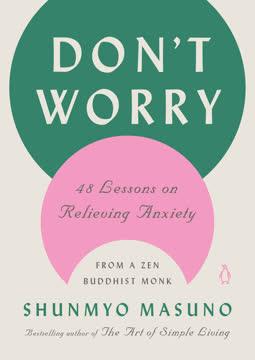
**Shunmyō Masuno**
*Estimated Reading Time: 75 to 90 minutes*
A Zen priest and garden designer offers a practical path to releasing what cannot be controlled, so your energy returns to what can. You will learn how to distinguish care from control, how to meet uncertainty with action instead of anxiety, how to protect your attention from the noise of modern life, and how to hold ambition without letting it hold you. This is not a book about not caring. It is a book about caring for the right things, in the right amount, at the right time.
Anyone who feels stretched thin by other people's demands, opinions, and expectations. Anyone who replays old mistakes or rehearses future disasters. Anyone who works hard but suspects they are working on the wrong things. Parents, managers, and partners who want to support the people they love without trying to run their lives. And anyone curious about how Zen wisdom translates into ordinary days.
Most of us are carrying too much. Not just in our schedules, but in our minds. There is the email we have not answered, the comment someone made last week, the decision we keep postponing, the future we keep imagining in vivid and unpleasant detail. None of these things are heavy on their own. Together they form a weight that follows us everywhere. Shunmyō Masuno, a Zen priest and one of Japan's most respected garden designers, has spent decades watching people carry this weight. As the chief priest of Kenkō-ji, a Sōtō Zen temple in Yokohama, and as a professor and designer whose gardens appear around the world, he works at the intersection of two disciplines that seem far apart but are not: the discipline of stillness and the discipline of making things. From that intersection comes a simple observation. People suffer less when they learn what to release. The problem is that "letting go" has become a slogan. It is said so often and so vaguely that it has lost its teeth. People hear it and imagine passivity, or giving up, or pretending not to care. Masuno's version is different. For him, letting go is not an act of surrender. It is an act of selection. It is the deliberate choice to stop spending energy on what cannot be changed so that energy remains for what can. This matters because attention is finite. Every unresolved demand competes for the same mental space, whether or not it can be solved. The mind does not naturally distinguish between a problem you can act on and a problem you can only worry about. It treats both as open loops and keeps returning to them. Over time, this produces a strange kind of…
Continue reading in the MinuteRead app
Get the complete 30-minute summary of How to Let Things Go
Get the complete summary in the appAsk whether action is possible now. If yes, act. If no, release.
Offer care without managing other adults.
Prepare where preparation helps, then stop rehearsing.
Choose your information diet deliberately.
Measure yourself against your own past.
Reflect on mistakes, but do not replay them.
"How to Let Things Go" is a strong fit if you want practical ideas around self help, psychology, spirituality, especially themes like ask whether action is possible now. if yes, act. if no, release; offer care without managing other adults. The MinuteRead summary distills these concepts into a focused read, whether you're deciding whether to buy the book or applying its lessons at work.
Motivated to help readers with 1) Let go selectively, Shunmyō Masuno wrote “How to Let Things Go” to package those ideas for a fast, focused read. In “How to Let Things Go”, Shunmyō Masuno focuses on 1) Let go selectively. Through “How to Let Things Go”, Shunmyō Masuno distills the core ideas on self help into lessons readers can absorb in a single short sitting. Readers turn to this work when they want Shunmyō Masuno's perspective on the subject without working through the entire original volum…
View all summaries by Shunmyō MasunoContinue Reading
Access the complete 30-minute summary and thousands more nonfiction books in the MinuteRead app.


Continue reading the complete summary in the MinuteRead app.