MinuteRead
30 min
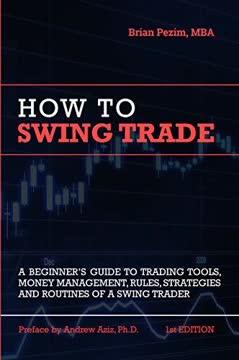
Book summary
by Brian Pezim
Premium summary · Opens in the app · 30 min read
Most people who enter the financial markets do so with a mixture of hope and confusion. They have heard stories of traders who made fortunes, and they have also heard stories of traders who lost everything. They know the markets offer opportunity, but they do not know how to access it without quitting their job, staring at screens for eight hours a day, or gambling their savings on hunches.
**Author:** Brian Pezim
**Estimated Reading Time:** 45 minutes
**What You'll Learn:**
- The core mechanics of swing trading and why it offers a practical middle path between day trading and long-term investing - How to read charts, identify patterns, and use technical indicators to time your entries and exits - The risk management rules that separate consistent winners from blown-up accounts - How to combine fundamental analysis with technical setups for stronger trade selection - The psychological traps that destroy traders and how to build emotional discipline - A complete framework for developing your own trading routine, journal, and improvement system
**Who This Book Is For:**
This book is for anyone who wants to actively trade the markets without being glued to a screen all day. It is for people who have a job, a family, or other commitments but still want to grow their capital through active trading. It is for beginners who need a clear, structured introduction to swing trading, and for experienced traders who want to refine their process and eliminate costly mistakes. If you are looking for a get-rich-quick scheme, this is not the book for you. If you are willing to learn a disciplined, repeatable approach to trading, you are in the right place.
Most people who enter the financial markets do so with a mixture of hope and confusion. They have heard stories of traders who made fortunes, and they have also heard stories of traders who lost everything. They know the markets offer opportunity, but they do not know how to access it without quitting their job, staring at screens for eight hours a day, or gambling their savings on hunches. This book exists to solve that problem. Swing trading is the answer for people who want to actively participate in the markets without becoming full-time day traders. It is a style of trading that captures meaningful price moves over a period of days to weeks. It does not require split-second decisions. It does not require you to monitor every tick of the market. It does require patience, discipline, and a structured approach. The problem most aspiring traders face is not a lack of information. It is a lack of structure. The internet is full of trading tips, hot stock picks, and conflicting advice. What is missing is a coherent framework that tells you how to find trades, how to manage risk, when to enter, when to exit, and how to improve over time. Brian Pezim wrote this book to provide that framework. Pezim has spent decades in the financial markets. He has seen what works and what fails. He has watched traders blow up their accounts by ignoring risk management. He has…
Continue reading in the MinuteRead app
Get the complete 30-minute summary of How To Swing Trade
Get the complete summary in the appSwing trading holds positions for days to weeks, capturing intermediate price moves.
Risk no more than 1% to 2% of your account on any single trade.
Always use stop-loss orders and never move them further away.
Aim for a risk-to-reward ratio of at least 1:2 on every trade.
Read charts by identifying trends, support, resistance, and patterns.
Use a small set of technical indicators: moving averages, RSI, MACD, and ATR.
"How To Swing Trade" is a strong fit if you want practical ideas around finance, business, money, especially themes like swing trading holds positions for days to weeks, capturing intermediate price moves; risk no more than 1% to 2% of your account on any single trade. The MinuteRead summary distills these concepts into a focused read, whether you're deciding whether to buy the book or applying its lessons at work.
Brian Pezim is an experienced trader and author specializing in swing trading. He has decades of experience in the financial markets and is known for his practical, no-nonsense approach to trading education. Pezim is associated with the Bear Bull Traders community and has written multiple books on trading strategies. He emphasizes risk management, technical analysis, and developing a structured trading routine. Pezim's writing style is described as clear and accessible, making complex trading co…
View all summaries by Brian PezimContinue Reading
Access the complete 30-minute summary and thousands more nonfiction books in the MinuteRead app.

Continue reading the complete summary in the MinuteRead app.