MinuteRead
15 min
Book summary
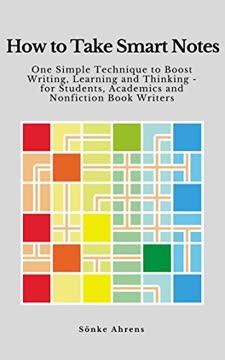
by Sönke Ahrens
Premium summary · Opens in the app · 30 min read
A young man walks into a university office in Germany, sits down across from a professor, and explains his plan. He wants to become a sociologist. He has read widely but published little. He knows he needs a system for turning his reading into writing, his ideas into arguments, his scattered thoughts into coherent work.
**Author:** Sönke Ahrens
**Estimated Reading Time:** 45 minutes
**What You'll Learn**
The simple but powerful note-taking system used by one of the most prolific social scientists of the twentieth century. You will discover why writing is not the result of thinking but the medium where thinking happens, how to build a network of interconnected ideas that grows smarter over time, and why the secret to effortless writing lies in the notes you take today.
**Who This Book Is For**
Anyone who has ever stared at a blank page, struggled to remember what they read, or felt overwhelmed by complex projects. Students who want to write better papers with less stress. Researchers and professionals who need to turn reading into original ideas. Writers who want to produce more without burning out. And anyone curious about how to think more clearly in a world overflowing with information.
A young man walks into a university office in Germany, sits down across from a professor, and explains his plan. He wants to become a sociologist. He has read widely but published little. He knows he needs a system for turning his reading into writing, his ideas into arguments, his scattered thoughts into coherent work. The year is 1963. The young man is Niklas Luhmann. And the system he describes that day will eventually produce over 70 books and more than 400 scholarly articles, making him one of the most prolific and influential sociologists of the twentieth century. When asked how he managed such extraordinary output, Luhmann gave a disarmingly simple answer: "I only do what is easy. I only write when I immediately know how to. If I falter for a moment, I put the matter aside and do something else." This sounds like the confession of a lazy genius, someone blessed with a mind so quick he never had to struggle. But the truth is far more interesting and far more useful. Luhmann was not relying on his brain. He was relying on his slip-box. The slip-box, or Zettelkasten in German, was a wooden cabinet filled with thousands of index cards. Each card contained a single idea, written in Luhmann's own words, connected to other cards through a careful system of links and references. Over three decades, this collection grew to 90,000 notes. But it was never just a storage system. It was a thinking partner, an external brain that allowed Luhmann to have conversations with his past self, to discover connections he never anticipated, and to develop complex arguments without ever facing a blank page. Most of us approach writing, learning, and thinking in exactly the wrong way. We read books and underline passages, only to forget them weeks later. We collect…
Continue reading in the MinuteRead app
Get the complete 30-minute summary of How to Take Smart Notes
Get the complete summary in the appWrite everything in your own words. If you cannot express an idea clearly, you have not understood it.
Take three types of notes: fleeting for capture, literature for digestion, permanent for development.
Each permanent note should contain exactly one idea, expressed fully and clearly.
Always connect new notes to existing ones. The value is in the network, not the collection.
Process your notes regularly. Unprocessed notes are just clutter.
Let arguments emerge from the bottom up. Do not impose structure before the ideas are ready.
"How to Take Smart Notes" is a strong fit if you want practical ideas around productivity, self help, writing—especially themes like write everything in your own words. if you cannot express an idea clearly, you have not understood it; take three types of notes: fleeting for capture, literature for digestion, permanent for development. The MinuteRead summary distills these concepts into a focused read, whether you're deciding whether to buy the book or applying its lessons at work.
Sönke Ahrens is a German academic and author known for his work on systematic education and productivity. As a professor at Hamburg University, he specializes in educational philosophy and has conducted extensive research on learning methods and knowledge management. Ahrens gained widespread recognition for popularizing the Zettelkasten note-taking method through his book "How to Take Smart Notes." His work combines insights from cognitive psychology, educational theory, and practical experience…
View all summaries by Sönke AhrensContinue Reading
Access the complete 30-minute summary and thousands more nonfiction books in the MinuteRead app.

Continue reading the complete summary in the MinuteRead app.