MinuteRead
30 min
Book summary
Premium summary · Opens in the app · 30 min read
There is a particular kind of relationship that leaves people feeling utterly bewildered. One moment, you are the most important person in someone's life. You are adored, idealized, needed. The next moment, without warning, you are the enemy. You are cold, uncaring, worthless. The person who clung to you yesterday now pushes you away with fury. And if you try to leave, they beg you to stay.
**Author:** Jerold J. Kreisman, M.D.
**Estimated Reading Time:** 45 minutes
**What You'll Learn:** The true nature of Borderline Personality Disorder, why it creates such chaotic relationships, how it develops, and practical strategies for communicating with and supporting someone who has it.
**Who This Book Is For:** Anyone who loves, lives with, works with, or treats someone whose emotions swing wildly between intense affection and furious rejection. It is also for those who recognize these patterns in themselves and want to understand what is happening.
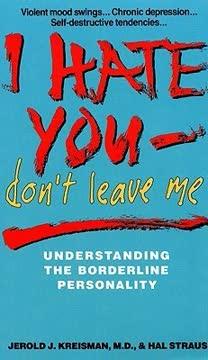
There is a particular kind of relationship that leaves people feeling utterly bewildered. One moment, you are the most important person in someone's life. You are adored, idealized, needed. The next moment, without warning, you are the enemy. You are cold, uncaring, worthless. The person who clung to you yesterday now pushes you away with fury. And if you try to leave, they beg you to stay. This pattern has a name. It is called Borderline Personality Disorder, or BPD. And it is far more common than most people realize. Approximately six percent of the population meets the criteria for this condition. That means millions of people are living with the chaos it creates. Millions more are affected indirectly: spouses, parents, children, siblings, friends, and coworkers who find themselves caught in a cycle of idealization and devaluation that they cannot understand. The title of this book captures the essence of the disorder in five words: "I hate you, don't leave me." It is the simultaneous push and pull that defines the borderline experience. It is the desperate need for closeness combined with an equally desperate fear of being hurt. It is the rage directed at the person whose love is most needed. Jerold Kreisman wrote this book to bridge a critical gap. For decades, BPD was misunderstood, misdiagnosed, and often dismissed. Mental health professionals themselves sometimes used the term "borderline" as a derogatory label for difficult patients. Families were left without guidance. Sufferers were left without hope. Kreisman offers something different. He explains the disorder with clarity and compassion. He shows that BPD is not a character flaw or a willful choice. It is a genuine illness with identifiable causes, predictable patterns, and effective treatments. More importantly, he provides practical tools for communication and support. The core challenge of BPD is that it distorts the very foundation of human connection. People with BPD experience emotions with extraordinary intensity. Their moods shift rapidly. Their sense of self is unstable. They see the world in black and white terms, with no room for gray. This makes relationships feel like minefields. Understanding this is the first step toward change. For the person with BPD, understanding means recognizing that their…
Continue reading in the MinuteRead app
Get the complete 30-minute summary of I Hate You--Don't Leave Me
Get the complete summary in the appBPD is a disorder of instability: unstable moods, unstable identity, unstable relationships, and unstable behavior.
Splitting is the core defense mechanism: people and situations are seen as all good or all bad, with no middle ground.
The fear of abandonment drives most borderline behaviors, including the "I hate you, don't leave me" dynamic.
BPD results from a combination of genetic vulnerability, environmental factors, and neurobiological differences.
The SET-UP approach (Support, Empathy, Truth, Understanding, Perseverance) provides a framework for effective communicat
Boundaries are essential. Clear limits, communicated consequences, and consistent follow-through create security.
"I Hate You--Don't Leave Me" is a strong fit if you want practical ideas around health & fitness, psychology, mental health, especially themes like bpd is a disorder of instability: unstable moods, unstable identity, unstable relationships, and unstable behavior; splitting is the core defense mechanism: people and situations are seen as all good or all bad, with no middle ground. The MinuteRead summary distills these concepts into a focused read, whether you're deciding whether to buy the book or applying its lessons at work.
Jerold J. Kreisman, M.D. is a renowned psychiatrist and author specializing in Borderline Personality Disorder. His best-selling books, including "I Hate You, Don't Leave Me" and "Sometimes I Act Crazy," have been translated into multiple languages, establishing him as a leading authority in the field. Kreisman holds the position of Associate Clinical Professor at St. Louis University and has been recognized as a Distinguished Life Fellow of the American Psychiatric Association. His expertise ha…
View all summaries by Jerold J. KreismanContinue Reading
Access the complete 30-minute summary and thousands more nonfiction books in the MinuteRead app.

Continue reading the complete summary in the MinuteRead app.