MinuteRead
30 min
Book summary
by Patrick King
Premium summary · Opens in the app · 30 min read
There is a quiet assumption most people carry through life: that social skills are something you either have or you don't. Some people are born charming, the thinking goes. Some people are naturally magnetic. The rest of us are left to fumble through conversations, misread signals, and wonder why certain relationships never quite click.
**Author:** Patrick King
**Estimated Reading Time:** 45 minutes
**What You'll Learn:**
- Why taking absolute ownership of your interactions transforms every relationship - How to uncover the hidden motivations driving human behavior - The toxic habits that silently repel people and how to eliminate them - How to listen in a way that makes others feel genuinely understood - The Platinum Rule and why it outperforms the Golden Rule - How to adapt your communication style to connect with anyone - Practical strategies for applying people skills in the workplace
**Who This Book Is For:**
Anyone who has ever walked away from a conversation wondering what went wrong. Anyone who feels socially stuck, professionally overlooked, or personally isolated. Anyone who suspects that better relationships are possible but doesn't know where to start. This book is for people who are ready to stop blaming circumstances and start building the social life they want.
There is a quiet assumption most people carry through life: that social skills are something you either have or you don't. Some people are born charming, the thinking goes. Some people are naturally magnetic. The rest of us are left to fumble through conversations, misread signals, and wonder why certain relationships never quite click. Patrick King challenges this assumption directly. Social skills are not a genetic lottery. They are not a mysterious talent bestowed on a lucky few. They are a set of learnable behaviors, built on a foundation of self-awareness, intentional practice, and a genuine willingness to understand other people. The problem is that most of us never treat people skills as skills at all. We treat them as personality traits. We say things like "I'm just awkward" or "I'm not good with people" as if these were permanent conditions, like height or eye color. But the truth is far more hopeful. The truth is that every interaction you have is an opportunity to practice. Every conversation is a chance to improve. Every relationship is a laboratory for learning. Why does this matter? Because the quality of your life is largely determined by the quality of your relationships. Your career trajectory depends on how well you work with colleagues and supervisors. Your personal happiness depends on the depth of your friendships and romantic partnerships. Your sense of belonging depends on your ability to connect with the people around you. People skills are not a nice-to-have. They are the foundation of a meaningful life. Yet most people struggle with this area more than any other. We are never formally taught how to listen well, how to navigate conflict, how to understand someone else's perspective, or how to manage our own emotional reactions. We are expected to pick these…
Continue reading in the MinuteRead app
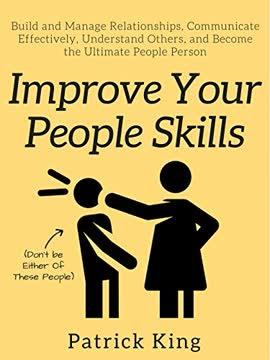
Get the complete 30-minute summary of Improve Your People Skills
Get the complete summary in the app**Take absolute ownership of your interactions.** You are the only person you can control. Stop blaming others and start
**Understand self-interest.** Everyone is driven by what benefits them. Figure out what people want and help them get it
**Eliminate toxic habits.** Removing negative behaviors is more powerful than adding positive ones.
**Question your assumptions.** Most conflicts stem from misunderstandings, not malice. Ask for clarity instead of assumi
**Listen with intent.** Give people air space. Repeat, rephrase, and summarize. Make them feel heard.
**Cultivate emotional intelligence.** Understand your emotions so you can respond thoughtfully rather than reacting impu
"Improve Your People Skills" is a strong fit if you want practical ideas around communication, self help, relationships, especially themes like **take absolute ownership of your interactions.** you are the only person you can control. stop blaming others and start; **understand self-interest.** everyone is driven by what benefits them. figure out what people want and help them get it. The MinuteRead summary distills these concepts into a focused read, whether you're deciding whether to buy the book or applying its lessons at work.
Patrick King is a Social Interaction Specialist based in San Francisco, California. He specializes in dating, online dating, image, communication, and social skills coaching. King is a #1 Amazon best-selling author, focusing on dating and relationships. His approach combines emotional intelligence and human psychology to help individuals build confidence and develop social skills. King's background includes three years of law school, which he leverages to provide practical, no-nonsense advice. H…
View all summaries by Patrick KingContinue Reading
Access the complete 30-minute summary and thousands more nonfiction books in the MinuteRead app.

Continue reading the complete summary in the MinuteRead app.