MinuteRead
30 min
Book summary
Premium summary · Opens in the app · 30 min read
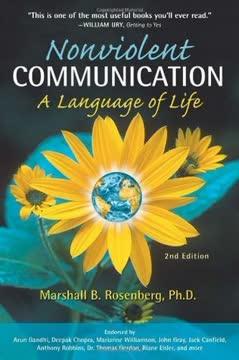
Marshall Rosenberg spent his life asking a deceptively simple question: what happens to disconnect us from our natural compassion, and what allows some people to stay connected to it even under difficult circumstances?
**Author:** Marshall B. Rosenberg **Estimated Reading Time:** 45 minutes
How to transform anger into understanding, conflict into connection, and everyday communication into a spiritual practice. You will discover why empathy heals, how honest self-expression creates intimacy, and what it truly means to give from the heart without obligation or resentment.
Anyone who has ever walked away from an argument feeling unheard. Parents tired of power struggles. Partners longing for deeper connection. Professionals navigating difficult conversations. Activists seeking lasting social change. And anyone who senses that the way we talk to each other is broken and wants a practical path toward something better.
Marshall Rosenberg spent his life asking a deceptively simple question: what happens to disconnect us from our natural compassion, and what allows some people to stay connected to it even under difficult circumstances? The question was not academic for him. Growing up in Detroit in the 1940s, Rosenberg witnessed race riots that killed more than forty people in his neighborhood. He saw how easily human beings could turn on one another. Yet he also saw something else. He noticed that some people seemed able to remain compassionate even when provoked, even when threatened, even when everyone around them was caught up in violence and blame. What was different about those people? What did they know that others did not? Rosenberg spent decades pursuing that question through the study of psychology, religion, and human behavior. He eventually earned a doctorate in clinical psychology from the University of Wisconsin, but the answers he found came less from academic research than from careful observation of what actually works when human beings try to understand one another. The result was Nonviolent Communication, a practice he developed and taught around the world for more than forty years. He worked with warring gangs, with couples on the edge of divorce, with prison inmates, with corporate executives, with teachers and parents and government officials. He mediated conflicts in Israel and Palestine, in Rwanda, in Sierra Leone, in Serbia. Wherever he went, he found that the same simple principles applied. Nonviolent Communication is often described as a communication technique, and it is that. It offers specific tools for expressing yourself honestly and listening to others with empathy. But Rosenberg was always clear that the technique was not the point. The point was something deeper. "It's really a spiritual practice that I am trying to show as a way of life," he said. This is the crucial distinction that separates Nonviolent Communication from other communication methods. You can learn the four steps of NVC in five minutes. You can practice them for a lifetime and still be learning. That is because NVC is not fundamentally about choosing…
Continue reading in the MinuteRead app
Get the complete 30-minute summary of Living Nonviolent Communication
Get the complete summary in the appAll violence is the tragic expression of unmet needs. Look for the need behind every behavior.
Anger is a signal, not an enemy. Trace it back to the unmet need and express the need, not the judgment.
Empathy is the cornerstone of healing. Be fully present with another's feelings and needs without trying to fix them.
Love is an action. Practice honest self-expression and empathic listening daily.
Give from the heart, not from obligation. Before giving, ask yourself if you are giving freely.
No one can make you angry. Your anger comes from your own thinking, which means you can change it.
"Living Nonviolent Communication" is a strong fit if you want practical ideas around psychology, self help, communication, especially themes like all violence is the tragic expression of unmet needs. look for the need behind every behavior; anger is a signal, not an enemy. trace it back to the unmet need and express the need, not the judgment. The MinuteRead summary distills these concepts into a focused read, whether you're deciding whether to buy the book or applying its lessons at work.
Marshall Rosenberg, Ph.D. was an American psychologist who developed Nonviolent Communication, a method for resolving conflicts peacefully. He founded the Center for Nonviolent Communication, an international non-profit organization. Rosenberg earned his doctorate in clinical psychology from the University of Wisconsin–Madison in 1961 and became a Diplomate in clinical psychology in 1966. His work focused on helping people exchange information effectively to resolve differences without violence.…
View all summaries by Marshall B. RosenbergContinue Reading
Access the complete 30-minute summary and thousands more nonfiction books in the MinuteRead app.

Continue reading the complete summary in the MinuteRead app.