MinuteRead
30 min
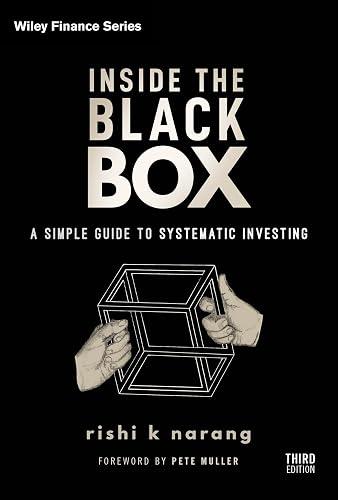
Book summary
by Rishi K. Narang
Premium summary · Opens in the app · 30 min read
In the spring of 2007, a quiet crisis began unfolding in the quantitative trading world. Over the course of a few days in August, some of the most sophisticated systematic funds on Wall Street experienced losses that their models suggested should occur only once every ten thousand years. The event forced a reckoning. Investors who had poured billions into quantitative strategies suddenly realized they did not understand what they owned. The funds were called "black boxes," and the label stuck.
**Author:** Rishi K. Narang
**Estimated Reading Time:** 45 minutes
**What You'll Learn:**
- How quantitative trading systems actually work, from data collection to execution - Why the "black box" is far more transparent than most people believe - The six core market phenomena that drive most quantitative strategies - How risk management in quant systems differs fundamentally from traditional approaches - What high-frequency trading really does and why most criticisms miss the mark - How to evaluate quantitative investment managers with confidence
**Who This Book Is For:**
This book is for anyone who has ever wondered what happens inside the mysterious world of quantitative trading. It is for investors who want to understand where their money goes when it enters a systematic fund. It is for finance professionals who need to evaluate quant strategies intelligently. It is for students and curious readers who suspect that the "black box" label obscures more than it reveals. And it is for discretionary traders who want to understand how their own intuitive processes might be systematized.
In the spring of 2007, a quiet crisis began unfolding in the quantitative trading world. Over the course of a few days in August, some of the most sophisticated systematic funds on Wall Street experienced losses that their models suggested should occur only once every ten thousand years. The event forced a reckoning. Investors who had poured billions into quantitative strategies suddenly realized they did not understand what they owned. The funds were called "black boxes," and the label stuck. But the label was always misleading. Quantitative trading is not magic. It is not a mysterious machine that spits out trading decisions without human oversight. It is not a collection of algorithms run amok. At its core, quantitative trading is simply the systematic implementation of trading strategies that human beings create through rigorous research. The "box" is not black at all. It is a transparent, structured process built from components that any thoughtful investor can understand. The confusion is understandable. Quantitative trading emerged from a collision of disciplines: mathematics, computer science, statistics, and finance. The practitioners spoke a language that sounded foreign to traditional investors. They used terms like "alpha models" and "portfolio optimizers" and "transaction cost functions." They built systems that processed millions of data points and executed thousands of trades in milliseconds. To an outsider, this looked like sorcery. But the underlying ideas are remarkably accessible. At the heart of every quantitative strategy lies a simple question: can we identify patterns in market behavior that persist over time and can be exploited for profit? This is the same question every investor asks, whether they are studying balance sheets, charting price movements, or reading news headlines. The…
Continue reading in the MinuteRead app
Get the complete 30-minute summary of Inside the Black Box
Get the complete summary in the appQuantitative trading is the systematic implementation of human-created strategies through rigorous research. It is not m
A quant system has five core components: alpha model, risk model, transaction cost model, portfolio construction model,
The alpha model is the profit engine. It predicts future returns using theory-driven or data-driven approaches.
Risk management is about intentional exposure, not risk avoidance. Take only the risks you intend to take.
Transaction costs can consume the entire alpha of a strategy. Model them explicitly and conservatively.
Portfolio construction balances profit, risk, and cost. It translates alpha predictions into positions.
"Inside the Black Box" is a strong fit if you want practical ideas around finance, business, economics, especially themes like quantitative trading is the systematic implementation of human-created strategies through rigorous research. it is not m; a quant system has five core components: alpha model, risk model, transaction cost model, portfolio construction model,. The MinuteRead summary distills these concepts into a focused read, whether you're deciding whether to buy the book or applying its lessons at work.
Motivated to help readers with quantitative trading can be defined as the systematic implementation of trading strategies that human beings, Rishi K. Narang wrote “Inside the Black Box” to package those ideas for a fast, focused read. In “Inside the Black Box”, Rishi K. Narang focuses on quantitative trading can be defined as the systematic implementation of trading strategies that human beings. Through “Inside the Black Box”, Rishi K. Narang distills the core ideas on finance into lessons reade…
Continue Reading
Access the complete 30-minute summary and thousands more nonfiction books in the MinuteRead app.

Continue reading the complete summary in the MinuteRead app.