MinuteRead
30 min
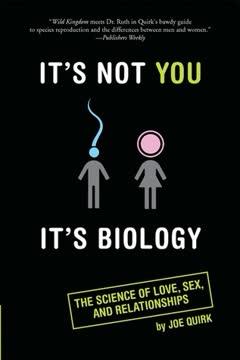
Book summary
by Joe Quirk
Premium summary · Opens in the app · 30 min read
Every relationship eventually reaches a moment of bewilderment. You find yourself staring at the person across the dinner table, wondering how someone so familiar can suddenly seem so alien. He wants one thing. She wants another. He says he needs space. She says she needs commitment. He cannot understand why she is upset. She cannot understand why he does not care.
**Author:** Joe Quirk **Estimated Reading Time:** 45 minutes
**What You'll Learn:**
Why men and women seem perpetually confused by each other. Why commitment terrifies some people and consummation terrifies others. Why kindness is sexy. Why testicle size reveals ancestral infidelity. Why art exists. Why love feels like temporary insanity. And why none of it is your fault.
**Who This Book Is For:**
Anyone who has ever wondered why their partner behaves in ways that seem inexplicable. Anyone who has blamed themselves for relationship failures that might actually be millions of years old. Anyone curious about the evolutionary forces that shape desire, attraction, jealousy, and love.
Every relationship eventually reaches a moment of bewilderment. You find yourself staring at the person across the dinner table, wondering how someone so familiar can suddenly seem so alien. He wants one thing. She wants another. He says he needs space. She says she needs commitment. He cannot understand why she is upset. She cannot understand why he does not care. Most relationship advice addresses this confusion with platitudes. Communicate more. Listen better. Try harder. But what if the problem is not communication? What if the problem is not effort? What if the problem is that two different reproductive agendas are colliding inside every relationship, and neither partner is consciously aware of what is driving them? Joe Quirk's central claim is both simple and radical. The battle of the sexes is not a social construction. It is not the result of bad parenting, toxic masculinity, or unrealistic romantic expectations. It is biology. Specifically, it is the biology of sperm and egg. Consider the fundamental asymmetry. A healthy man produces millions of sperm every day. Each one is cheap, expendable, and easily replaced. A healthy woman produces approximately four hundred eggs in her entire lifetime. Each one represents a significant biological investment. Pregnancy costs her nine months of physical resources, followed by years of dependent childcare. For a man, reproduction can theoretically take minutes. For a woman, it takes years. This asymmetry shapes everything. It shapes who pursues and who chooses. It shapes who fears commitment and who fears abandonment. It shapes what men find attractive in women and what women find attractive in men. It shapes jealousy, infidelity, competition, and even art. Quirk is not a scientist. He is a novelist and self-described independent scholar who read widely in evolutionary biology and decided to translate the findings into language ordinary people could understand and enjoy. The result is a book that is irreverent, funny, and occasionally outrageous. But beneath the humor is a serious argument grounded in decades of research in evolutionary psychology, anthropology, and comparative biology. The title captures the book's central reassurance. It…
Continue reading in the MinuteRead app
Get the complete 30-minute summary of It's Not You, It's Biology.
Get the complete summary in the appSperm are cheap and abundant. Eggs are expensive and scarce. This asymmetry shapes everything about human mating.
Men are attracted to signs of fertility. Women are attracted to signs of resourcefulness.
Testicle size reveals the level of female promiscuity in a species. Human testicles suggest a history of moderate infide
Men fear commitment because it limits their options. Women fear consummation without commitment because it risks pregnan
Attention is a form of currency. The individuals who command attention are more likely to receive resources and attract
Art evolved as a courtship display. Creativity signals genetic fitness.
"It's Not You, It's Biology." is a strong fit if you want practical ideas around inspiration, science, psychology, especially themes like sperm are cheap and abundant. eggs are expensive and scarce. this asymmetry shapes everything about human mating; men are attracted to signs of fertility. women are attracted to signs of resourcefulness. The MinuteRead summary distills these concepts into a focused read, whether you're deciding whether to buy the book or applying its lessons at work.
Joe Quirk is a novelist and self-proclaimed "independent scholar" who wrote "It's Not You, It's Biology." Despite lacking formal scientific credentials, Quirk conducted extensive research to explore evolutionary biology and its impact on human relationships. His writing style blends humor with scientific concepts, aiming to make complex topics accessible to a general audience. Quirk's approach is controversial, with some praising his ability to engage readers on scientific subjects, while others…
View all summaries by Joe QuirkContinue Reading
Access the complete 30-minute summary and thousands more nonfiction books in the MinuteRead app.

Continue reading the complete summary in the MinuteRead app.