MinuteRead
30 min
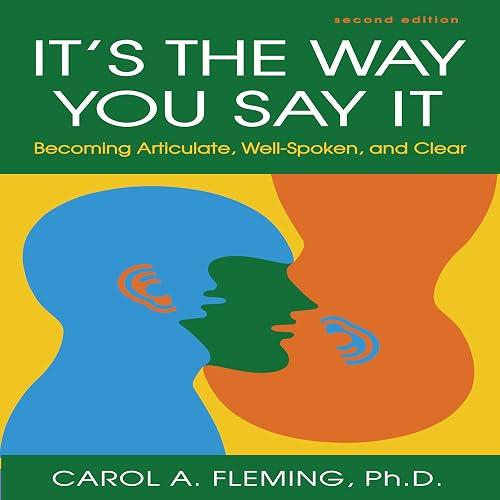
Book summary
by Carol A. Fleming
Premium summary · Opens in the app · 30 min read
There is a peculiar moment that nearly everyone has experienced. You hear a recording of your own voice and think, with genuine alarm, "That cannot possibly be me." The voice sounds thinner, higher, flatter, or somehow entirely foreign. You may have laughed it off, but that moment of disconnection reveals something profound: the voice you hear inside your head is not the voice the rest of the world hears.
**Author:** Carol A. Fleming
**Estimated Reading Time:** 45 minutes
**What You'll Learn:** How to understand, assess, and transform your speaking voice so that it accurately reflects who you are and what you want to communicate. You will discover why people misjudge their own voices, how to fix common speech problems, and how to develop a voice that commands attention and respect.
**Who This Book Is For:** Anyone who has ever been surprised by the sound of their recorded voice, professionals who want to communicate with greater authority, people who struggle with specific speech habits, and anyone who suspects their voice is holding them back from being fully understood.
There is a peculiar moment that nearly everyone has experienced. You hear a recording of your own voice and think, with genuine alarm, "That cannot possibly be me." The voice sounds thinner, higher, flatter, or somehow entirely foreign. You may have laughed it off, but that moment of disconnection reveals something profound: the voice you hear inside your head is not the voice the rest of the world hears. This gap between self-perception and reality sits at the heart of Carol Fleming's work. For decades, she has helped people confront an uncomfortable truth. The way you sound has an enormous impact on how you are perceived, judged, and understood. Yet most people have almost no accurate awareness of their own vocal characteristics. They speak too quickly without knowing it. They mumble without realizing it. They trail off at the ends of sentences, speak in a monotone, or use a pitch that undermines their authority, all while believing their communication is perfectly clear. The consequences of this blindness are not trivial. A voice that is too soft suggests timidity. A voice that is too fast suggests anxiety. A voice that never varies suggests boredom or disengagement. People form impressions within seconds of hearing someone speak, and those impressions shape everything from hiring decisions to romantic connections to everyday social interactions. Your voice is not merely a vehicle for your words. It is a signal about who you are. Fleming's central insight is that this is not a fixed condition. The voice is not an unchangeable inheritance like eye color or height. It is a set of habits, shaped by years of unconscious practice, and habits can be changed. The first step is the hardest: developing an accurate picture of how you actually sound. This requires external feedback, because your own ears cannot be trusted. The voice you hear when you speak is conducted through the bones of your skull, which alters its quality. You literally hear yourself differently than everyone else does. Once you have an accurate picture, the work of improvement can…
Continue reading in the MinuteRead app
Get the complete 30-minute summary of It's the Way You Say It
Get the complete summary in the appYour self-perception of your voice is distorted. Recordings and external feedback are essential.
Your voice is a set of habits, and habits can be changed through deliberate practice.
Slow down. A deliberate pace signals confidence and gives listeners time to process.
Breathe from your diaphragm. Proper breath support is the foundation of a strong voice.
Vary your pitch, volume, and pace. Vocal variety engages listeners and reveals your emotions.
Pause. Pauses create clarity, emphasis, and rhythm. They are signs of confidence.
"It's the Way You Say It" is a strong fit if you want practical ideas around communication, self help, psychology, especially themes like your self-perception of your voice is distorted. recordings and external feedback are essential; your voice is a set of habits, and habits can be changed through deliberate practice. The MinuteRead summary distills these concepts into a focused read, whether you're deciding whether to buy the book or applying its lessons at work.
Motivated to help readers with people are not good judges of their own speaking characteristics, Carol A. Fleming wrote “It's the Way You Say It” to package those ideas for a fast, focused read. In “It's the Way You Say It”, Carol A. Fleming focuses on people are not good judges of their own speaking characteristics. Through “It's the Way You Say It”, Carol A. Fleming distills the core ideas on communication into lessons readers can absorb in a single short sitting. Readers turn to this work whe…
Continue Reading
Access the complete 30-minute summary and thousands more nonfiction books in the MinuteRead app.

Continue reading the complete summary in the MinuteRead app.