MinuteRead
30 min
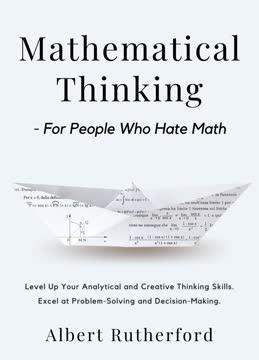
Book summary
Premium summary · Opens in the app · 30 min read
Most people leave math class with a profound sense of relief and a quiet conviction that they will never need it again. They remember formulas they memorized and forgot, problems they solved without understanding, and the sinking feeling of staring at a test question that might as well have been written in another language. For many, math was something to survive, not something to learn.
**Author:** Albert Rutherford
**Estimated Reading Time:** 45 minutes
**What You'll Learn:**
- Why the math you learned in school secretly taught you how to think, not just calculate - How to make your arguments precise, testable, and convincing - A four-step framework for solving problems that transfers to every area of life - Why walking away from hard problems helps your brain solve them - How to calculate expected value before making important decisions - Why assuming trends continue in straight lines leads to terrible predictions - Practical strategies for learning faster and retaining more
**Who This Book Is For:**
Anyone who believes they are "not a math person." Anyone who sat through algebra wondering when they would ever use it. Anyone who wants to think more clearly, argue more persuasively, and make better decisions. You do not need to remember how to solve quadratic equations. You need to understand the thinking that made those equations possible.
Most people leave math class with a profound sense of relief and a quiet conviction that they will never need it again. They remember formulas they memorized and forgot, problems they solved without understanding, and the sinking feeling of staring at a test question that might as well have been written in another language. For many, math was something to survive, not something to learn. This book argues that the real value of math was never the formulas. It was the thinking. Mathematical thinking is not the same as doing math. It is not memorizing multiplication tables or solving for x. It is the reasoning behind the formulas, the mental habits that mathematicians develop, and the way of approaching problems that transfers to every domain of life. When you learned to prove your work in geometry, you were learning how to build an argument. When you learned to test a hypothesis with examples, you were learning how to avoid jumping to conclusions. When you learned to check your answers, you were learning intellectual humility. The problem is that almost nobody taught you this explicitly. Math class focused on procedures: do this step, then this step, then this step. The deeper lessons remained hidden, buried under worksheets and timed tests. Students who struggled with the procedures concluded they were bad at math, and by extension, bad at the kind of thinking math requires. They walked away believing that analytical thinking was not for them. That belief is wrong. And it is costly. We live in a world that increasingly rewards the skills mathematical thinking develops. The procedural math we once needed is vanishing. Apps measure angles. Receipts calculate tips. Search engines solve integrals. But the demand for abstract thinkers, problem-solvers, and analyzers keeps growing.…
Continue reading in the MinuteRead app
Get the complete 30-minute summary of Mathematical Thinking - For People Who Hate Math
Get the complete summary in the appMathematical thinking is the reasoning behind the formulas, not the formulas themselves.
Make your claims true or false. Strip "maybe" from your arguments.
Use Mason's four steps: conjecture, specialize, generalize, convince.
Document where you get stuck. Wrong turns teach more than right answers.
Question your first instinct. The Einstellung effect blinds you to better solutions.
Alternate between focused and diffuse thinking. Walk away from hard problems.
"Mathematical Thinking - For People Who Hate Math" is a strong fit if you want practical ideas around inspiration, mathematics, science, especially themes like mathematical thinking is the reasoning behind the formulas, not the formulas themselves; make your claims true or false. strip "maybe" from your arguments. The MinuteRead summary distills these concepts into a focused read, whether you're deciding whether to buy the book or applying its lessons at work.
Albert Rutherford is an author known for writing books that aim to make complex subjects more accessible to general readers. While specific biographical information is limited in the given content, Albert Rutherford's writing style is described as having a pleasant "literary voice" that readers find engaging. His approach to presenting topics is generally considered uncomplicated and unassuming, making his books suitable for light reading or as alternatives to mindless entertainment. Rutherford …
View all summaries by Albert RutherfordContinue Reading
Access the complete 30-minute summary and thousands more nonfiction books in the MinuteRead app.

Continue reading the complete summary in the MinuteRead app.