MinuteRead
30 min
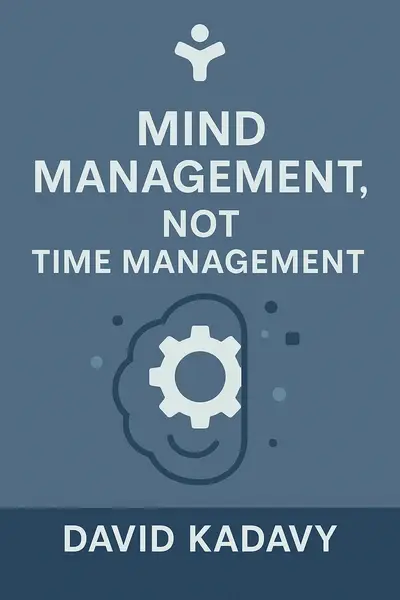
Book summary
by David Kadavy
Premium summary · Opens in the app · 30 min read
For over a century, productivity advice has been built on a single assumption: time is the resource you need to manage. Plan your day. Block your calendar. Squeeze more tasks into fewer hours. Optimize every minute. This approach made perfect sense when most work was industrial. If you were assembling widgets on a factory line, the relationship between time and output was direct. Work more hours, produce more widgets. Time management worked because time was the bottleneck.
**Author:** David Kadavy **Estimated Reading Time:** 45 minutes
Why managing your time is no longer enough in an economy that rewards creative thinking. You'll discover how to identify your Creative Sweet Spot, harness the four stages of creativity, work with seven distinct mental states, build creative cycles that prevent burnout, and create systems that turn your ideas into finished work even when life gets chaotic.
Anyone whose work depends on generating ideas, solving problems, or producing original content. If you've ever felt guilty for not being productive during certain hours, frustrated that forcing yourself to work harder doesn't produce better results, or confused about why some days your mind flows while others it stalls, this book will change how you think about productivity entirely.
For over a century, productivity advice has been built on a single assumption: time is the resource you need to manage. Plan your day. Block your calendar. Squeeze more tasks into fewer hours. Optimize every minute. This approach made perfect sense when most work was industrial. If you were assembling widgets on a factory line, the relationship between time and output was direct. Work more hours, produce more widgets. Time management worked because time was the bottleneck. But something fundamental has shifted. Most of us no longer assemble widgets. We write, design, code, strategize, problem-solve, and create. Our output isn't measured in units produced per hour. It's measured in the quality of our ideas, the originality of our solutions, and the impact of our creative work. And here's the problem: creative work doesn't follow the linear logic of industrial work. You can't simply decide to have a brilliant idea at 2:00 PM because that's when your calendar says it's time to be brilliant. David Kadavy discovered this truth through years of trial and error as a writer, designer, and entrepreneur. He noticed something strange about his own productivity. Some hours, he could write thousands of words effortlessly. Other hours, he'd stare at a blank screen, forcing out sentences that felt lifeless and would need to be rewritten anyway. The difference wasn't how much time he had. It was the state of his mind. This observation led him to a deeper investigation. What if productivity isn't about managing time at all? What if it's about managing mental energy, cognitive states, and creative rhythms? What if the reason so many of us feel burned out and frustrated is that we're applying industrial-age solutions to creative-age problems? The stakes are higher than just feeling productive. When you force creative work during the wrong mental state, you don't just waste time. You produce inferior work. You train your brain to associate creativity with struggle. You burn through mental energy that…
Continue reading in the MinuteRead app
Get the complete 30-minute summary of Mind Management, Not Time Management
Get the complete summary in the appManage your mind, not your time. The quality of your mental state determines the quality of your creative work.
Find your Creative Sweet Spot and protect it fiercely. These hours are worth ten times more than your other hours.
Honor the four stages of creativity. Don't skip incubation. It's essential for breakthroughs.
Match your tasks to your seven mental states. Don't try to be creative when your brain wants to organize.
Work in cycles. Focus, rest, repeat. Hitting a wall is a signal to rest, not to push harder.
Define your Minimum Creative Dose. Make it small enough that you can do it even on your worst days.
"Mind Management, Not Time Management" is a strong fit if you want practical ideas around productivity, self help, personal development, especially themes like manage your mind, not your time. the quality of your mental state determines the quality of your creative work; find your creative sweet spot and protect it fiercely. these hours are worth ten times more than your other hours. The MinuteRead summary distills these concepts into a focused read, whether you're deciding whether to buy the book or applying its lessons at work.
David Kadavy is a bestselling author, blogger, podcaster, and speaker known for his work on productivity and creativity. Through his blog, kadavy.net, and podcast, Love Your Work, he guides individuals in finding fulfillment through their crafts, often exploring unconventional paths. Kadavy's writing has been featured in various publications, including Quartz, Observer, and The Huffington Post. He has spoken at events like SXSW and TEDx across eight countries. Currently residing in Medellín, Col…
View all summaries by David KadavyContinue Reading
Access the complete 30-minute summary and thousands more nonfiction books in the MinuteRead app.

Continue reading the complete summary in the MinuteRead app.