MinuteRead
30 min
Book summary
Premium summary · Opens in the app · 30 min read
Most people believe their emotions are caused by events. A difficult conversation leads to anger. A setback at work leads to depression. A crowded room leads to anxiety. This explanation feels natural because it matches our daily experience. Something happens, and we feel something in response.
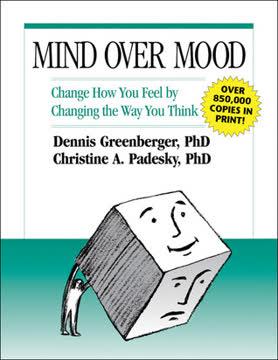
### Change How You Feel by Changing the Way You Think
**Author:** Dennis Greenberger, PhD, with Christine A. Padesky, PhD
**Estimated Reading Time:** 45 minutes
**What You'll Learn**
How your thoughts, moods, behaviors, and physical reactions form an interconnected system, and how to intervene in that system to create lasting emotional change. You will learn practical skills drawn from cognitive behavioral therapy, including how to identify and rate moods, challenge negative thinking, face fears gradually, manage anger, overcome shame, build new core beliefs, and prevent relapse.
**Who This Book Is For**
Anyone who has ever felt stuck in a pattern of anxiety, depression, anger, guilt, or shame. Whether you are working with a therapist or navigating these challenges on your own, this condensed edition gives you the tools to understand your emotional life and change it from the inside out.
Most people believe their emotions are caused by events. A difficult conversation leads to anger. A setback at work leads to depression. A crowded room leads to anxiety. This explanation feels natural because it matches our daily experience. Something happens, and we feel something in response. But this simple cause-and-effect story misses something important. Between the event and the emotion stands a powerful interpreter: your mind. The way you think about what happens to you shapes how you feel about it. Two people can experience the same event and walk away with completely different emotional reactions. One person loses a job and sees a catastrophe. Another loses the same job and sees an opportunity. The event is identical. The interpretation is not. This insight sits at the heart of cognitive behavioral therapy, one of the most thoroughly researched and consistently effective approaches to emotional well-being ever developed. The premise is simple but profound: if your thoughts influence your emotions, then changing your thoughts can change your emotions. You are not at the mercy of your moods. You have more power than you realize. The challenge is that most of us have never been taught how to work with our thoughts. We treat our thinking as if it were a direct recording of reality rather than an interpretation of it. When a thought appears, we believe it. When a mood descends, we assume it reflects the truth. When anxiety tightens our chest, we conclude that danger must be near. We rarely pause to examine whether our interpretations are accurate, balanced, or helpful. Mind Over Mood was written to fill that gap. Dennis Greenberger and Christine Padesky, both clinical psychologists with decades of experience, created a practical guide that translates the principles of cognitive behavioral therapy into skills anyone can learn. The book has become one of the most widely used resources…
Continue reading in the MinuteRead app
Get the complete 30-minute summary of Mind Over Mood
Get the complete summary in the appYour thoughts, moods, behaviors, physical reactions, and environment are interconnected. Change one, and you can change
Thoughts are not facts. They are interpretations that can be evaluated and revised.
Rate your moods on a 0 to 100 scale to track patterns and measure progress.
Use the thought record to gather evidence for and against your automatic thoughts.
Action precedes motivation. Do things that are likely to help, even when you do not feel like it.
Face your fears gradually. Stay in feared situations until your anxiety decreases.
"Mind Over Mood" is a strong fit if you want practical ideas around health & fitness, psychology, self help, especially themes like your thoughts, moods, behaviors, physical reactions, and environment are interconnected. change one, and you can change; thoughts are not facts. they are interpretations that can be evaluated and revised. The MinuteRead summary distills these concepts into a focused read, whether you're deciding whether to buy the book or applying its lessons at work.
Dennis Greenberger is a clinical psychologist and co-author of Mind Over Mood. He has extensive experience treating patients with various mental health issues, including those at high risk for suicide. Greenberger is known for his work in cognitive therapy and has a particular interest in making this therapeutic approach accessible to both professionals and the general public. He has contributed significantly to the field of cognitive behavioral therapy, developing practical tools and techniques…
View all summaries by Dennis GreenbergerContinue Reading
Access the complete 30-minute summary and thousands more nonfiction books in the MinuteRead app.

Continue reading the complete summary in the MinuteRead app.