MinuteRead
30 min
Every day, millions of people wake up with clear intentions. They plan to exercise, to eat better, to write, to save money, to stop scrolling through their phones. They know what they should do. They understand the consequences of not doing it. And yet, when the moment comes to act, something else takes over.
**Author:** Peter Hollins
**Estimated Reading Time:** 45 minutes
**What You'll Learn:**
- Why your brain actively works against your long-term goals - How to act before fear and procrastination take hold - The science of building discipline through environmental design - Practical techniques to rewire your brain for consistent action - How to make discomfort work for you instead of against you
**Who This Book Is For:**
Anyone who has ever known exactly what they should do, yet found themselves doing the opposite. If you have struggled with procrastination, abandoned goals, or wondered why willpower alone never seems to be enough, this book will show you what is actually happening in your brain and how to work with it rather than against it.
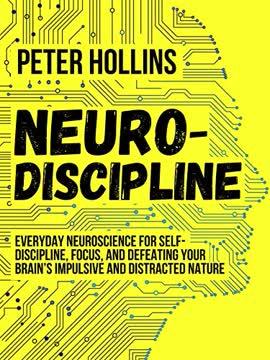
Every day, millions of people wake up with clear intentions. They plan to exercise, to eat better, to write, to save money, to stop scrolling through their phones. They know what they should do. They understand the consequences of not doing it. And yet, when the moment comes to act, something else takes over. That something is not a character flaw. It is not laziness in the moral sense. It is not a lack of ambition or desire. It is your brain doing exactly what it evolved to do. Peter Hollins begins Neuro-Discipline with a simple observation that reframes the entire challenge of self-control. Our brains are programmed to do as little work as possible, seek maximum pleasure, and generally bask in the sun like a house cat. This is not a metaphor. It is a description of how the human brain actually operates. The brain consumes up to twenty percent of our daily energy despite being only two percent of our body mass. It is an energy-hungry organ, and it has evolved to conserve that energy whenever possible. This creates a fundamental tension. The part of your brain that wants to plan for the future, delay gratification, and work toward distant goals is relatively new in evolutionary terms. It is slow, deliberate, and energy-intensive. The part of your brain that wants immediate pleasure, comfort, and safety is ancient. It is fast, automatic, and incredibly efficient. When these two systems conflict, the ancient system usually wins. The problem is not that you lack willpower. The problem is that you are trying to fight a battle with the wrong weapons. You are attempting to use rational arguments against a system that does not respond to rational arguments. You are trying to out-think a process that operates below the level of conscious thought. This is why traditional advice about discipline so often fails. Telling someone to just try harder assumes that the problem is insufficient effort. It ignores the…
Continue reading in the MinuteRead app
Get the complete 30-minute summary of Neuro-Discipline
Get the complete summary in the appYour brain has two systems: a fast, emotional limbic system and a slow, rational prefrontal cortex. The emotional system
Act within five seconds of feeling an impulse toward a goal. Count down 5-4-3-2-1 and physically move before your emotio
Your future self feels like a stranger. Use the 10-10-10 rule to make future consequences feel real: how will you feel i
Pre-decide your responses using if-then plans. If X happens, then I will do Y. This removes the need for in-the-moment w
Design your environment so the disciplined choice requires less effort than the undisciplined choice. Make discipline th
Break large tasks into small pieces. Anything difficult is only a series of easy things. Small wins create dopamine rewa
"Neuro-Discipline" is a strong fit if you want practical ideas around inspiration, psychology, self help, especially themes like your brain has two systems: a fast, emotional limbic system and a slow, rational prefrontal cortex. the emotional system; act within five seconds of feeling an impulse toward a goal. count down 5-4-3-2-1 and physically move before your emotio. The MinuteRead summary distills these concepts into a focused read, whether you're deciding whether to buy the book or applying its lessons at work.
Peter Hollins is a prominent figure in the field of human psychology and personal development. With a bachelor's degree in psychology and a graduate degree, he has established himself as a bestselling author and researcher. Hollins' work focuses on understanding the human condition and exploring the intricacies of human psychology. His writing style is known for its accessibility and practical approach, making complex psychological concepts understandable to a wide audience. As an author, Hollin…
View all summaries by Peter HollinsContinue Reading
Access the complete 30-minute summary and thousands more nonfiction books in the MinuteRead app.

Continue reading the complete summary in the MinuteRead app.