MinuteRead
30 min
Book summary
Premium summary · Opens in the app · 30 min read
Social anxiety has a peculiar quality. It convinces you that you are uniquely flawed, that everyone else knows how to navigate conversations effortlessly, and that your discomfort is visible to all. You rehearse what you might say, then criticize yourself afterward for saying the wrong thing. You avoid certain situations entirely, or endure them with a racing heart and a mind scanning for signs of judgment.
### A Self-Help Course
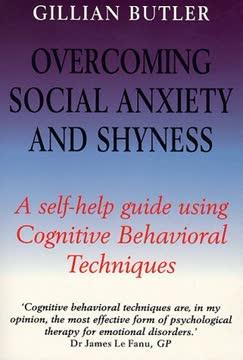
**Author:** Gillian Butler **Estimated Reading Time:** 45 minutes
**What You'll Learn:** - Why social anxiety persists despite your best efforts to control it - How thoughts, feelings, and behaviors form a cycle that keeps anxiety alive - Practical cognitive behavioral techniques to break that cycle - How to reduce self-consciousness and shift your attention outward - Ways to face feared situations gradually and systematically - How to build lasting confidence through behavioral experiments
**Who This Book Is For:** Anyone who feels held back by shyness or social anxiety. Whether you struggle with everyday conversations, speaking up in meetings, attending social gatherings, or simply being yourself around others, this book provides a structured path toward greater ease and confidence.
Social anxiety has a peculiar quality. It convinces you that you are uniquely flawed, that everyone else knows how to navigate conversations effortlessly, and that your discomfort is visible to all. You rehearse what you might say, then criticize yourself afterward for saying the wrong thing. You avoid certain situations entirely, or endure them with a racing heart and a mind scanning for signs of judgment. The cost of this pattern is enormous. It limits career opportunities, strains relationships, and drains the joy from what should be ordinary human connection. Yet most people who struggle with social anxiety never seek help. They assume it is simply part of who they are, a fixed personality trait rather than a solvable problem. Gillian Butler, a clinical psychologist with decades of experience in cognitive behavioral therapy, offers a different perspective. Social anxiety is not a character flaw. It is a learned pattern of thinking and behaving that can be unlearned. The discomfort you feel in social situations is not evidence of inadequacy. It is the result of specific, identifiable processes that keep anxiety alive. The approach in this book rests on a simple but profound insight: your thoughts, feelings, and behaviors influence each other constantly. When you think negatively about a social situation, you feel anxious. When you feel anxious, you behave in ways that seem protective, such as avoiding eye contact or speaking quietly. These behaviors then reinforce your negative thoughts, creating a self-perpetuating cycle. Most attempts to overcome social anxiety fail because they target only one part of this cycle. You might try to think more positively but continue avoiding situations, so your anxious predictions never get tested. You might force yourself into social situations but rely on safety behaviors that prevent you from learning anything new. Or you might try to relax without addressing the thoughts that trigger anxiety in the first place. Butler's approach is different. She provides a comprehensive framework for understanding how social anxiety works…
Continue reading in the MinuteRead app
Get the complete 30-minute summary of Overcoming Social Anxiety and Shyness Self-help Course
Get the complete summary in the appSocial anxiety is maintained by a cycle of thoughts, feelings, and behaviors that reinforce each other.
Your anxious thoughts are interpretations, not facts. Challenge them with evidence.
Confidence follows action. Act despite your anxiety, and the anxiety will decrease.
Safety behaviors reinforce the belief that you need protection. Reduce them gradually.
Avoidance strengthens anxiety. Face your fears through gradual exposure.
Shift your attention outward. The less self-conscious you are, the easier social interaction becomes.
"Overcoming Social Anxiety and Shyness Self-help Course" is a strong fit if you want practical ideas around self help, psychology, mental health, especially themes like social anxiety is maintained by a cycle of thoughts, feelings, and behaviors that reinforce each other; your anxious thoughts are interpretations, not facts. challenge them with evidence. The MinuteRead summary distills these concepts into a focused read, whether you're deciding whether to buy the book or applying its lessons at work.
Gillian Butler is a clinical psychologist and author specializing in cognitive behavioral therapy (CBT). She has written several self-help books on anxiety, depression, and related topics. Butler's work focuses on providing practical strategies for managing mental health issues using CBT techniques. She has extensive clinical experience and is known for her ability to explain complex psychological concepts in accessible language. Butler's books are often recommended by healthcare professionals a…
View all summaries by Gillian ButlerContinue Reading
Access the complete 30-minute summary and thousands more nonfiction books in the MinuteRead app.

Continue reading the complete summary in the MinuteRead app.