MinuteRead
30 min
Book summary
Premium summary · Opens in the app · 30 min read
Imagine you are standing on a train platform, waiting for your morning commute. You are a kind person, a gentle person, someone who has never intentionally harmed anyone. Suddenly, without warning, a thought flashes through your mind: "I could push that stranger onto the tracks."
**Author:** Sally M. Winston, PsyD
**Estimated Reading Time:** 45 minutes
**What You'll Learn:** Why disturbing thoughts appear in your mind, what they actually mean, why trying to stop them makes them worse, and how to fundamentally change your relationship with them so they lose their power over your life.
**Who This Book Is For:** Anyone who has ever been frightened by their own thoughts. If you have experienced a sudden violent image, a disturbing sexual idea, a blasphemous notion, or a terrifying doubt that seemed to come from nowhere and made you question who you really are, this book is for you. It is also for those who love someone struggling with these experiences and want to understand what is actually happening.
Imagine you are standing on a train platform, waiting for your morning commute. You are a kind person, a gentle person, someone who has never intentionally harmed anyone. Suddenly, without warning, a thought flashes through your mind: "I could push that stranger onto the tracks." Your stomach drops. Your heart races. You step back from the edge, horrified. Where did that come from? What kind of person thinks something like that? You spend the rest of the day replaying the moment, searching your memory for evidence that you are secretly violent, secretly dangerous, secretly broken. If this sounds familiar, you are not alone. You are not crazy. And you are not a monster. The experience of unwanted intrusive thoughts is one of the most common and least discussed features of the human mind. Studies suggest that the vast majority of people, perhaps as many as ninety percent, experience intrusive thoughts at some point in their lives. These thoughts can be violent, sexual, blasphemous, or simply bizarre. They can involve harming loved ones, committing taboo acts, or questioning fundamental aspects of identity and reality. They arrive unbidden, feel alien and disturbing, and often leave the thinker shaken and confused. The problem is not the thoughts themselves. The problem is what happens next. When a disturbing thought appears, most people have a brief moment of discomfort and then move on. They recognize it as mental noise, as a glitch in the system, as something that does not reflect who they are. But for some people, the thought sticks. It feels significant. It feels like a warning, a revelation, or a threat. And once that interpretation takes hold, a painful cycle begins. The more you try to understand the thought, the more confusing it becomes. The more you try to suppress it, the more frequently it returns. The more you seek reassurance that you are not dangerous, the less reassured you feel. Before long, you are trapped in a spiral of…
Continue reading in the MinuteRead app
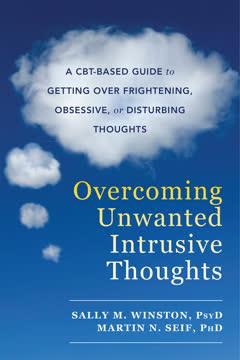
Get the complete 30-minute summary of Overcoming Unwanted Intrusive Thoughts
Get the complete summary in the appIntrusive thoughts are normal. Up to ninety percent of people experience them at some point.
The content of your thoughts does not reflect your character. Good people have awful thoughts.
Trying to suppress thoughts makes them stronger. What you resist persists.
The anxious thinking state distorts your perception. You cannot trust your anxious interpretations.
Acceptance is the key to freedom. Stop fighting the thoughts and they lose their power.
Exposure teaches your brain that the thoughts are not dangerous. Approach what you fear.
"Overcoming Unwanted Intrusive Thoughts" is a strong fit if you want practical ideas around health & fitness, psychology, self help, especially themes like intrusive thoughts are normal. up to ninety percent of people experience them at some point; the content of your thoughts does not reflect your character. good people have awful thoughts. The MinuteRead summary distills these concepts into a focused read, whether you're deciding whether to buy the book or applying its lessons at work.
Sally M. Winston PsyD is a psychologist and expert in anxiety disorders and obsessive-compulsive disorder (OCD). She is the co-director of the Anxiety and Stress Disorders Institute of Maryland and has extensive experience in treating patients with anxiety-related issues. Winston is known for her work in cognitive-behavioral therapy (CBT) and has contributed significantly to the field of anxiety treatment. She has co-authored several books on anxiety and intrusive thoughts, combining her clinica…
View all summaries by Sally M. WinstonContinue Reading
Access the complete 30-minute summary and thousands more nonfiction books in the MinuteRead app.

Continue reading the complete summary in the MinuteRead app.