MinuteRead
30 min
Book summary
Premium summary · Opens in the app · 30 min read
Every day, you attempt something extraordinarily difficult. You try to take a thought, a feeling, a need, or an intention that exists inside your mind and transfer it into the mind of another person. You do this using words, gestures, tone of voice, and facial expressions. Then the other person tries to do the same thing back to you.
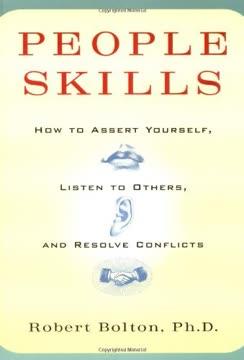
**Author:** Robert Bolton **Estimated Reading Time:** 42 minutes
How to close the gap between what you mean to say and what others actually hear. You'll discover why most communication failures follow predictable patterns, how to listen in a way that transforms conversations, and how to express yourself with clarity and respect even in difficult moments.
Anyone who has ever walked away from a conversation feeling misunderstood. Anyone who has struggled to say no without feeling guilty. Anyone who has watched a minor disagreement spiral into a lasting conflict. If you interact with other human beings, this book addresses the fundamental skills that determine the quality of those interactions.
Every day, you attempt something extraordinarily difficult. You try to take a thought, a feeling, a need, or an intention that exists inside your mind and transfer it into the mind of another person. You do this using words, gestures, tone of voice, and facial expressions. Then the other person tries to do the same thing back to you. Most of the time, the transfer is imperfect. Sometimes it fails completely. Consider how often you have said something you believed was perfectly clear, only to discover the other person heard something entirely different. Consider how often you have listened carefully to someone, only to find later that you missed the emotional core of what they were trying to tell you. Consider how many relationships, careers, and opportunities have been damaged not by malice or incompetence, but by the simple failure to communicate effectively. Robert Bolton wrote People Skills to address this fundamental human challenge. The book emerged from decades of research and practical training in communication skills. Bolton drew from psychology, counseling, and organizational development to identify what actually works when people try to understand each other. The result is not a collection of tricks or manipulative techniques. It is a systematic approach to becoming more genuine, more understanding, and more effective in every relationship. The problem Bolton identifies is what he calls the interpersonal gap. This gap exists between what one person intends to communicate and what another person actually receives. Every message must cross this gap, and the crossing is fraught with obstacles. Your emotional state, your assumptions about the other person, your habits of speech, your cultural background, your fears and defenses: all of these can distort the message as it travels from sender to receiver. Most people respond to communication failures by trying harder. They repeat themselves more loudly. They explain the same point using different words. They become frustrated when the other person still doesn't understand. But the problem is rarely effort. The problem is skill. Think of communication like any other complex human activity. You wouldn't…
Continue reading in the MinuteRead app
Get the complete 30-minute summary of People Skills
Get the complete summary in the appCommunication is a learnable skill, not an innate talent.
Roadblocks like judging, advising, and diverting damage communication even when well-intentioned.
Listening is active: attend, follow, and reflect.
Reflect both content and feeling to demonstrate understanding.
Assertion is the middle path between nonassertion and aggression.
Use the three-part assertion message: behavior, feeling, tangible effect.
"People Skills" is a strong fit if you want practical ideas around communication, self help, psychology, especially themes like communication is a learnable skill, not an innate talent; roadblocks like judging, advising, and diverting damage communication even when well-intentioned. The MinuteRead summary distills these concepts into a focused read, whether you're deciding whether to buy the book or applying its lessons at work.
Robert Bolton is a renowned expert in communication and interpersonal skills. He holds a Ph.D. and has dedicated his career to teaching and writing about effective communication. Bolton's work focuses on practical techniques for improving listening, assertion, and conflict resolution. He is known for his scientific approach, combining research with real-world examples. Bolton's writing style is described as clear and thorough, making complex concepts accessible to readers. His book "People Skill…
View all summaries by Robert BoltonContinue Reading
Access the complete 30-minute summary and thousands more nonfiction books in the MinuteRead app.

Continue reading the complete summary in the MinuteRead app.