MinuteRead
30 min
Book summary
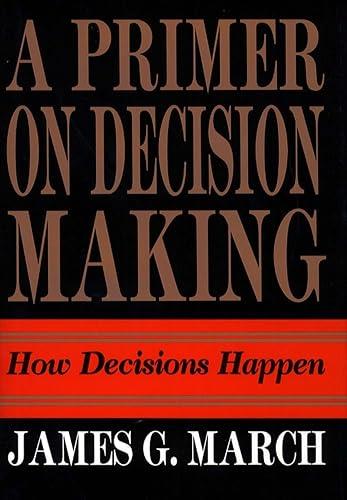
by James G. March
Premium summary · Opens in the app · 30 min read
Every day, in organizations around the world, people make decisions. They choose which products to launch, which employees to promote, which strategies to pursue, and which problems to ignore. The standard story about how these decisions happen is comforting in its clarity. We gather information. We identify alternatives. We evaluate the likely consequences of each option. We select the one that best serves our goals.
**Author:** James G. March
**Estimated Reading Time:** 45 minutes
**What You'll Learn:**
- Why the rational model of decision making fails to explain how choices actually happen - How identity and rules shape decisions more powerfully than calculation - Why ambiguity is not an obstacle to decision making but its natural habitat - How power, attention, and timing influence organizational choices - What it means to make decisions that construct meaning, not just outcomes - How to balance exploring new possibilities with exploiting existing strengths
**Who This Book Is For:**
This book is for anyone who has ever sat in a meeting wondering why a group made a decision that no individual member would have chosen alone. It is for managers who suspect that the spreadsheets and analyses they produce serve purposes other than informing choices. It is for students of organizations who want to understand how institutions actually function, not how they are supposed to function. And it is for anyone curious about the strange, messy, and deeply human process by which we decide what to do.
Every day, in organizations around the world, people make decisions. They choose which products to launch, which employees to promote, which strategies to pursue, and which problems to ignore. The standard story about how these decisions happen is comforting in its clarity. We gather information. We identify alternatives. We evaluate the likely consequences of each option. We select the one that best serves our goals. This story is taught in business schools. It is embedded in decision support software. It is assumed by economists, policy analysts, and management consultants. And it is, for the most part, wrong. James G. March spent his career studying how decisions actually happen in real organizations. What he found was not a tidy process of rational calculation but something far more interesting. Decisions emerge from a complex interplay of identities, rules, attention, power, ambiguity, and meaning. They are shaped by cognitive limits that prevent us from considering all options. They are driven by questions of who we are rather than what we want. They are embedded in organizational processes that often seem designed to produce anything but rational choice. This book is a primer on that reality. It does not dismiss the logic of consequence, the idea that we choose actions based on their expected outcomes. That logic remains important. But it places that logic alongside another, equally important logic: the logic of appropriateness, the idea that we choose actions based on what is fitting for someone in our position, in this situation, given our identity and the rules we follow. The difference between these two logics is profound. When a doctor decides how to treat a…
Continue reading in the MinuteRead app
Get the complete 30-minute summary of Primer on Decision Making
Get the complete summary in the app**Two logics drive decisions.** The logic of consequence calculates outcomes. The logic of appropriateness follows rules
**Ask three questions.** What kind of situation is this? What kind of person am I? What does someone like me do in a sit
**Rationality is bounded.** Attention, memory, and processing capacity are limited. Satisficing is often more rational t
**Attention is power.** What gets attended to gets decided. The ability to direct attention, your own and others', is cr
**Politics is inherent.** Organizations are collections of actors with inconsistent preferences. Coalition building and
**Ambiguity is pervasive.** Problems, solutions, and decision makers flow independently. Timing often matters more than
"Primer on Decision Making" is a strong fit if you want practical ideas around management, business, psychology, especially themes like **two logics drive decisions.** the logic of consequence calculates outcomes. the logic of appropriateness follows rules; **ask three questions.** what kind of situation is this? what kind of person am i? what does someone like me do in a sit. The MinuteRead summary distills these concepts into a focused read, whether you're deciding whether to buy the book or applying its lessons at work.
Motivated to help readers with decision makers are imagined to ask (explicitly or implicitly) three questions: The question of recognition:, James G. March wrote “Primer on Decision Making” to package those ideas for a fast, focused read. In “Primer on Decision Making”, James G. March focuses on decision makers are imagined to ask (explicitly or implicitly) three questions: The question of recognition:. Through “Primer on Decision Making”, James G. March distills the core ideas on management int…
Continue Reading
Access the complete 30-minute summary and thousands more nonfiction books in the MinuteRead app.

Continue reading the complete summary in the MinuteRead app.