MinuteRead
30 min
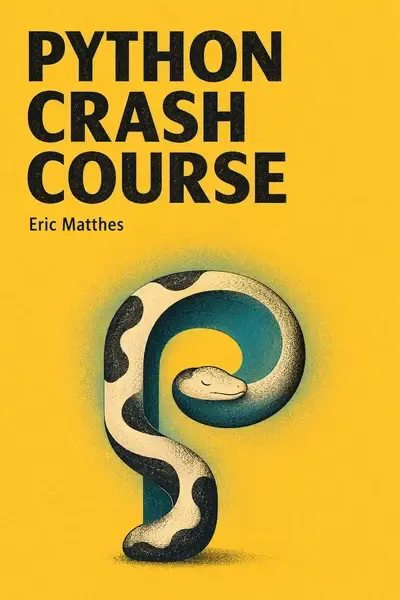
Book summary
by Eric Matthes
Premium summary · Opens in the app · 30 min read
Most programming books fail their readers. They bury beginners in syntax rules, abstract concepts, and theoretical explanations before the reader ever writes a line of meaningful code. By chapter three, the aspiring programmer has memorized twenty function names but has no idea what programming actually feels like. They know what a variable is but cannot imagine why anyone would use one. The book becomes a reference manual rather than a teacher, and the reader quietly gives up.
**A Hands-On, Project-Based Introduction to Programming**
**Author:** Eric Matthes **Estimated Reading Time:** 4 hours **What You'll Learn:** How to write real Python programs, build interactive games, create data visualizations, and develop web applications through project-based learning. **Who This Book Is For:** Complete beginners who want to learn programming by building things, and anyone who has tried to learn Python before but got lost in theory without practical application.
Most programming books fail their readers. They bury beginners in syntax rules, abstract concepts, and theoretical explanations before the reader ever writes a line of meaningful code. By chapter three, the aspiring programmer has memorized twenty function names but has no idea what programming actually feels like. They know what a variable is but cannot imagine why anyone would use one. The book becomes a reference manual rather than a teacher, and the reader quietly gives up. Eric Matthes wrote Python Crash Course to solve this problem. His approach is radically simple: get the reader building real projects as quickly as possible, and teach the theory along the way. The book does not start with a history of computer science or a taxonomy of data types. It starts by helping you write a program that does something you can see. Then it shows you another. Then it asks you to build something yourself. This matters because programming is a craft, not a body of knowledge. You cannot learn it by reading. You learn it by typing, breaking things, fixing them, and gradually developing an intuition for how code behaves. Matthes understands this deeply. His book is structured as a series of projects that increase in complexity, each one introducing new concepts exactly when you need them. You learn about classes because your game requires them. You learn about APIs because your visualization project demands real data. The motivation is built into the structure. The book addresses a genuine struggle: the gap between understanding individual programming concepts and knowing how to combine them into a working program. Many learners can explain what a loop does but freeze when asked to build something from scratch. Python Crash Course closes this gap by making synthesis the primary activity. Every chapter asks you to extend what you have built, to modify it, to break it intentionally and then repair it. By the end, you have not just read about Python. You have written thousands of lines of it. Python itself is the ideal language for this approach. Its syntax is clean and readable. Its community is enormous and supportive. Its libraries let beginners do sophisticated things with remarkably little code. A complete novice can build a data visualization of global temperature trends in an afternoon. A…
Continue reading in the MinuteRead app
Get the complete 30-minute summary of Python Crash Course
Get the complete summary in the app**Indentation is syntax.** Python uses it to determine code structure. Be consistent.
**Lists and dictionaries solve different problems.** Lists for order, dictionaries for lookup by name.
**Functions prevent repetition.** Write once, call many times, change in one place.
**Classes organize complex programs.** Group related data and behavior together.
**Use `with open()` for files.** It handles closing automatically and prevents resource leaks.
**Handle exceptions with try-except.** Catch specific errors and respond gracefully.
"Python Crash Course" is a strong fit if you want practical ideas around programming, computer science, coding, especially themes like **indentation is syntax.** python uses it to determine code structure. be consistent; **lists and dictionaries solve different problems.** lists for order, dictionaries for lookup by name. The MinuteRead summary distills these concepts into a focused read, whether you're deciding whether to buy the book or applying its lessons at work.
Eric Matthes is a highly regarded author in the field of Python programming education. His writing style is praised for its clarity, organization, and ability to make complex concepts accessible to beginners. Matthes has a reputation for creating engaging, project-based learning experiences that help readers apply their newly acquired skills in practical ways. He is known for his dedication to his students and his passion for teaching programming. Matthes' approach focuses on providing just enou…
View all summaries by Eric MatthesContinue Reading
Access the complete 30-minute summary and thousands more nonfiction books in the MinuteRead app.

Continue reading the complete summary in the MinuteRead app.