MinuteRead
30 min
Book summary
Premium summary · Opens in the app · 30 min read
Imagine walking into a doctor's office with back pain that has been bothering you for months. The doctor orders an MRI. A few days later, you sit in a cold examination room while someone points to a screen and says the words "bulging disc," "degeneration," or "arthritis." Suddenly, you have a diagnosis. You have a label. You also have a new fear that your spine is damaged, fragile, and possibly broken beyond repair.
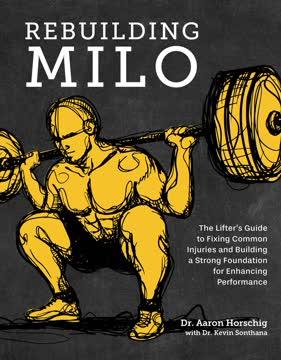
**Author:** Aaron Horschig **Estimated Reading Time:** 42 minutes
**What You'll Learn:**
- Why MRI scans often mislead people about the true source of their pain - How to classify back, hip, knee, and shoulder pain based on movement patterns - The exact screening process used by elite physical therapists to find pain triggers - How to rebuild your body from pain to high performance using progressive loading - The core stability exercises that protect your spine during heavy lifting - How individual anatomy changes the way you should squat, hinge, and press
**Who This Book Is For:**
This book is for anyone who has ever experienced pain during training and been told something vague like "rest it" or "stop lifting heavy." It is for the lifter who has been handed an MRI report filled with scary words and no clear path forward. It is for the athlete who wants to understand why their body hurts and what to do about it. It is for the coach who wants a systematic way to help clients move better and train pain-free. And it is for the everyday person who simply wants to bend over, pick something up, and stand back up without fear.
Imagine walking into a doctor's office with back pain that has been bothering you for months. The doctor orders an MRI. A few days later, you sit in a cold examination room while someone points to a screen and says the words "bulging disc," "degeneration," or "arthritis." Suddenly, you have a diagnosis. You have a label. You also have a new fear that your spine is damaged, fragile, and possibly broken beyond repair. Now imagine a different scenario. You walk into a physical therapist's office with the same back pain. Instead of ordering an MRI, the therapist asks you to move. Bend forward. Bend backward. Squat. Lift this weight. Show me what hurts. Within twenty minutes, the therapist has identified that your pain only appears when you round your lower back under load. The solution is not surgery or a lifetime of avoiding movement. The solution is learning to hinge at your hips, building core stability, and gradually rebuilding your capacity to move. These two scenarios represent fundamentally different approaches to pain. The first treats the body as a collection of parts that can be photographed and labeled. The second treats the body as a system that moves, adapts, and heals. Aaron Horschig wrote Rebuilding Milo to bridge the gap between these two worlds. As a physical therapist and strength coach, he has spent years working with athletes who were told their bodies were broken based on imaging results. He has seen powerlifters with terrifying MRI reports continue to…
Continue reading in the MinuteRead app
Get the complete 30-minute summary of Rebuilding Milo
Get the complete summary in the appMRI findings correlate poorly with pain. Many people with structural abnormalities have no pain at all.
Pain is a movement problem, not a structural problem. Find the movement that triggers your pain.
Power equals Force times Velocity. Avoid combining heavy loads with spinal movement.
Classify your back pain as flexion, extension, rotation, or load intolerance. Each type requires a different approach.
Core stability is about stiffness, not strength. Use isometric exercises like the McGill Big Three.
The hip hinge is the most important movement pattern for protecting your spine during bending and lifting.
"Rebuilding Milo" is a strong fit if you want practical ideas around health & fitness, fitness, health, especially themes like mri findings correlate poorly with pain. many people with structural abnormalities have no pain at all; pain is a movement problem, not a structural problem. find the movement that triggers your pain. The MinuteRead summary distills these concepts into a focused read, whether you're deciding whether to buy the book or applying its lessons at work.
Aaron Horschig is a highly respected expert in sports rehabilitation and injury prevention, particularly in the field of weightlifting. He is known for his work as the founder of Squat University, a popular online resource for athletes and fitness enthusiasts. Horschig's approach combines his expertise as a physical therapist with practical experience in strength training. He emphasizes understanding the root causes of injuries and addressing them holistically, rather than focusing solely on sym…
View all summaries by Aaron HorschigContinue Reading
Access the complete 30-minute summary and thousands more nonfiction books in the MinuteRead app.

Continue reading the complete summary in the MinuteRead app.