MinuteRead
21 min
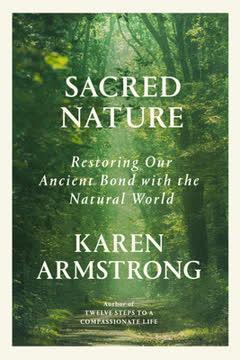
There is a moment in the Book of Job that feels almost unbearably modern. Job, a man who has lost everything, demands that God explain why he has suffered. He wants answers. He wants logic. He wants the world to make sense according to his understanding of justice.
**Author:** Karen Armstrong
**Estimated Reading Time:** 45 minutes
**What You'll Learn:**
* Why ancient cultures saw nature as sacred and alive, and why we stopped * How the loss of mythos created our environmental crisis * What spiritual traditions can teach us about reverence, sacrifice, and compassion * Practical ways to rebuild a meaningful relationship with the natural world
**Who This Book Is For:**
Anyone who senses that our environmental crisis is not merely technological or political but spiritual. Anyone who has stood in a forest, by an ocean, or under a star-filled sky and felt something they could not name. Anyone ready to move beyond guilt and despair toward a renewed way of seeing and living.
There is a moment in the Book of Job that feels almost unbearably modern. Job, a man who has lost everything, demands that God explain why he has suffered. He wants answers. He wants logic. He wants the world to make sense according to his understanding of justice. God's response is not an answer. It is a question. And then another. And another. Where were you when I laid the foundation of the earth? Who shut in the sea with doors when it burst out from the womb? Do you know when the mountain goats give birth? Do you observe the calving of the deer? For four chapters, God speaks not of human concerns but of the wild, uncontrollable, magnificent natural world. The whirlwind. The sea. The constellations. The ostrich. The horse. The hawk. The Leviathan. God does not explain suffering. Instead, God invites Job to look up from his own anguish and behold something larger, something that does not revolve around human beings at all. This is the book Karen Armstrong believes we desperately need to read again. We live in a time of environmental crisis. The facts are well known. Climate change. Biodiversity loss. Pollution. Resource depletion. We have more scientific knowledge about the natural world than any generation before us. We can measure carbon dioxide levels in the atmosphere with extraordinary precision. We can track the decline of species across the globe. We can model the future of the planet with sophisticated computer programs. And yet, something is missing. We know about nature. But we do not feel nature. We study it. But we do not revere it. We manage it. But we do not love it. Armstrong argues that this is not simply a failure of policy or technology. It is a failure of the heart. For most of human history, people did not merely observe the natural world. They participated in it. They felt themselves embedded within it. They experienced it as sacred, alive, and meaningful. The wind…
Continue reading in the MinuteRead app
Get the complete 30-minute summary of Sacred Nature
Get the complete summary in the appThe environmental crisis is a spiritual crisis, not just a technical one.
For most of human history, people experienced nature as sacred and alive.
The loss of mythos has left us without the resources to understand why nature matters.
We must recover the experience of holiness in the natural world.
Sacrifice is not a burden but a liberation.
Gratitude transforms our relationship with the Earth.
"Sacred Nature" is a strong fit if you want practical ideas around nature, religion, spirituality, especially themes like the environmental crisis is a spiritual crisis, not just a technical one; for most of human history, people experienced nature as sacred and alive. The MinuteRead summary distills these concepts into a focused read, whether you're deciding whether to buy the book or applying its lessons at work.
Karen Armstrong is a renowned author specializing in comparative religion. She has written numerous books on various religious topics, including "The Case for God," "A History of God," and "Islam." Armstrong's work has been translated into 45 languages, demonstrating her global influence. In 2008, she was awarded the TED Prize and worked on the Charter for Compassion, a collaborative effort involving multiple religious traditions. Armstrong has received several accolades for her contributions to…
View all summaries by Karen ArmstrongContinue Reading
Access the complete 30-minute summary and thousands more nonfiction books in the MinuteRead app.

Continue reading the complete summary in the MinuteRead app.