MinuteRead
30 min
Book summary
Premium summary · Opens in the app · 30 min read
Walk into any commercial gym and you will hear conflicting advice about how to build muscle. One person insists you must lift heavy weights for low repetitions. Another swears by high-volume training with lighter loads. Someone else claims the secret is in the timing of your protein shake. The fitness industry thrives on this confusion, selling certainty where little exists.
**Author:** Brad Schoenfeld
**Estimated Reading Time:** 45 minutes
**What You'll Learn:**
- The three primary mechanisms that drive muscle growth - How to structure resistance training for maximum hypertrophy - The role of nutrition in building muscle - Why individual factors like genetics and age matter - How to apply periodization for long-term progress
**Who This Book Is For:**
This book is for anyone who wants to understand the science behind building muscle. Whether you are a personal trainer, coach, physique athlete, recreational lifter, or simply someone curious about how the human body adapts to resistance training, this condensed edition will give you the evidence-based foundation you need. No advanced degree in physiology is required, but a willingness to engage with real science is.
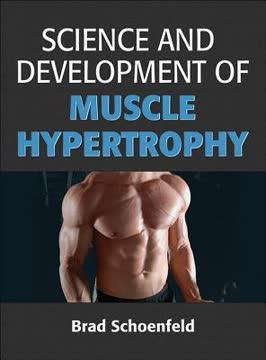
Walk into any commercial gym and you will hear conflicting advice about how to build muscle. One person insists you must lift heavy weights for low repetitions. Another swears by high-volume training with lighter loads. Someone else claims the secret is in the timing of your protein shake. The fitness industry thrives on this confusion, selling certainty where little exists. Brad Schoenfeld wrote *Science and Development of Muscle Hypertrophy* to cut through the noise. As one of the world's leading researchers on resistance training, Schoenfeld has spent his career asking a simple question: What does the evidence actually show? The answer, it turns out, is both more nuanced and more practical than most gym debates suggest. Muscle hypertrophy, the increase in muscle fiber size, is not a mysterious process reserved for genetic outliers. It is a predictable biological response to specific stimuli. When you understand the mechanisms that trigger muscle growth, you can design training programs that exploit those mechanisms deliberately rather than accidentally. The problem is that most people train based on tradition, anecdote, or marketing. They copy routines from magazines without understanding why those routines work, when they work, or for whom they work. This leads to years of effort with suboptimal results. Worse, it leads to the belief that building muscle is more complicated than it actually is. Schoenfeld's approach is different. He treats muscle hypertrophy as a scientific problem with identifiable variables. By examining the research on each variable, from training volume to rest intervals to protein intake, he provides a framework for making informed decisions about your training. This is not a book of rigid rules. It is a book of principles that can be adapted to individual circumstances. The stakes are higher than aesthetics. Muscle mass is a key component of metabolic health, functional capacity, and quality of life as we age. Understanding how to build and maintain muscle is relevant to everyone, not just bodybuilders. The same principles that…
Continue reading in the MinuteRead app
Get the complete 30-minute summary of Science and Development of Muscle Hypertrophy
Get the complete summary in the appMechanical tension is the primary driver of muscle hypertrophy.
Training volume is a key variable. Higher volumes generally produce greater growth.
Train each muscle group two to three times per week for optimal frequency.
A wide range of loads works for hypertrophy when sets are performed close to failure.
Use both compound and isolation exercises for complete development.
Consume 1.6 to 2.2 grams of protein per kilogram of body weight daily.
"Science and Development of Muscle Hypertrophy" is a strong fit if you want practical ideas around health & fitness, fitness, health, especially themes like mechanical tension is the primary driver of muscle hypertrophy; training volume is a key variable. higher volumes generally produce greater growth. The MinuteRead summary distills these concepts into a focused read, whether you're deciding whether to buy the book or applying its lessons at work.
Brad J. Schoenfeld is a renowned expert in exercise science and muscle hypertrophy. As a professor at Lehman College, he has published over 300 peer-reviewed papers and authored influential books in the field. Schoenfeld's research has been widely cited, and he is ranked as the top researcher on resistance training by ExpertScape. His contributions have earned him prestigious awards, including the Dwight D. Eisenhower Fitness Award and the NSCA Young Investigator of the Year Award. Beyond academ…
View all summaries by Brad SchoenfeldContinue Reading
Access the complete 30-minute summary and thousands more nonfiction books in the MinuteRead app.

Continue reading the complete summary in the MinuteRead app.