MinuteRead
30 min
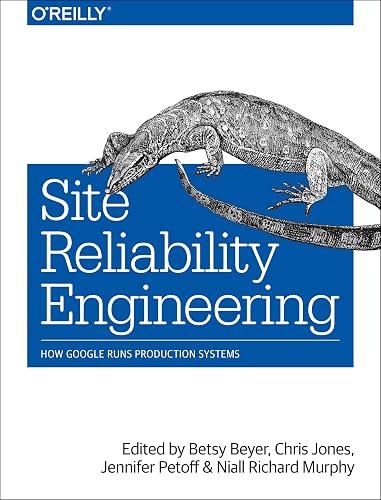
Book summary
by Betsy Beyer
Premium summary · Opens in the app · 30 min read
Every company that runs software in production eventually faces the same tension. The people who build software want to ship new features quickly. The people who keep software running want stability and predictability. These two goals seem to pull in opposite directions, and most organizations resolve the tension poorly.
**Author:** Betsy Beyer (Editor, with contributions from Google's SRE team)
**Estimated Reading Time:** 45 minutes
**What You'll Learn:** - Why 100% reliability is the wrong target for almost every service - How error budgets transform reliability from a technical goal into a business decision - What separates toil from real engineering work, and why eliminating it matters - How to design monitoring systems that alert humans only when they truly need to act - Why blameless postmortems are the foundation of organizational learning - How to think about distributed systems, load balancing, and cascading failures at scale
**Who This Book Is For:** This book is for software engineers who find themselves responsible for production systems. It is for operations professionals who want to apply engineering rigor to their work. It is for engineering leaders who need a framework for balancing reliability with feature velocity. And it is for anyone who has ever been paged at 3 a.m. and wondered if there is a better way.
Every company that runs software in production eventually faces the same tension. The people who build software want to ship new features quickly. The people who keep software running want stability and predictability. These two goals seem to pull in opposite directions, and most organizations resolve the tension poorly. The traditional solution is to create an operations team. Developers write code and hand it to operations, who deploy it, monitor it, and fix it when it breaks. This division creates a wall between building and running software. Developers optimize for shipping features. Operations optimizes for keeping systems stable. Each side develops its own incentives, its own culture, and its own vocabulary. The result is often a slow-motion conflict: developers complain that operations is too slow and bureaucratic, while operations complains that developers are reckless and don't care about reliability. Google faced this problem at a scale few companies can imagine. By the early 2000s, Google was running an enormous fleet of services across globally distributed datacenters. The traditional operations model was breaking down. There simply were not enough operations engineers to manage the complexity manually. The company needed a fundamentally different approach. The answer was Site Reliability Engineering, or SRE. The core insight was simple but radical: what if you asked software engineers to design and run the operations function? What if the people responsible for keeping systems reliable were the same kind of people who build systems in the first place? Instead of hiring operators to manage systems manually, Google hired software engineers and gave them a mandate to solve operational problems with code. This book is the definitive account of how Google's SRE teams work. It was written by the people who created…
Continue reading in the MinuteRead app
Get the complete 30-minute summary of Site Reliability Engineering
Get the complete summary in the appReliability is a feature that should be engineered deliberately, not pursued as an absolute goal.
100% reliability is almost never the right target. Define explicit Service Level Objectives based on what users actually
The error budget is the mechanism for balancing reliability and innovation. If the budget remains, ship features. If it
Toil is manual, repetitive, automatable work that provides no lasting value. Eliminate it through automation.
Monitoring should never require a human to interpret any part of the alerting domain. Every alert should be actionable w
The four golden signals are latency, traffic, errors, and saturation. Monitor them for every service.
"Site Reliability Engineering" is a strong fit if you want practical ideas around technology, computer science, programming, especially themes like reliability is a feature that should be engineered deliberately, not pursued as an absolute goal; 100% reliability is almost never the right target. define explicit service level objectives based on what users actually. The MinuteRead summary distills these concepts into a focused read, whether you're deciding whether to buy the book or applying its lessons at work.
Motivated to help readers with sRE is what happens when you ask a software engineer to design an operations team, Betsy Beyer wrote “Site Reliability Engineering” to package those ideas for a fast, focused read. In “Site Reliability Engineering”, Betsy Beyer focuses on sRE is what happens when you ask a software engineer to design an operations team. Through “Site Reliability Engineering”, Betsy Beyer distills the core ideas on technology into lessons readers can absorb in a single short sitting…
Continue Reading
Access the complete 30-minute summary and thousands more nonfiction books in the MinuteRead app.

Continue reading the complete summary in the MinuteRead app.