MinuteRead
30 min
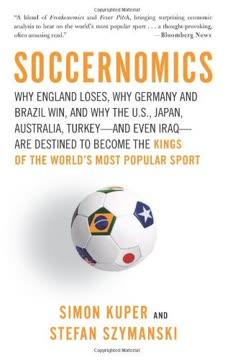
Book summary
by Simon Kuper
Premium summary · Opens in the app · 30 min read
Soccer is the world's most popular sport, yet it is also one of the most misunderstood. Every weekend, hundreds of millions of people watch matches, argue about tactics, criticize managers, and debate transfer decisions. Most of these conversations are built on intuition, tradition, and emotion. Very few are built on evidence.
**Author:** Simon Kuper with Stefan Szymanski
**Estimated Reading Time:** 45 minutes
**What You'll Learn:**
- Why soccer clubs are terrible businesses that almost never die - How data and economics reveal truths that fans and pundits miss - Why the transfer market is full of irrational decisions and how smart clubs exploit them - What actually happens to a country's economy and happiness when it hosts a World Cup - Why England underperforms and what the data says about the real reasons - Where global soccer is heading and which nations will dominate next
**Who This Book Is For:**
This book is for anyone who loves soccer but suspects the conventional wisdom around it is wrong. It is for fans who want to understand why their club makes baffling decisions, for readers curious about the hidden economics of the world's most popular sport, and for anyone who enjoys seeing deeply held beliefs tested against hard data. You do not need to be an economist to read this book. You only need to be curious about why soccer works the way it does.
Soccer is the world's most popular sport, yet it is also one of the most misunderstood. Every weekend, hundreds of millions of people watch matches, argue about tactics, criticize managers, and debate transfer decisions. Most of these conversations are built on intuition, tradition, and emotion. Very few are built on evidence. This book began with a simple observation: soccer is full of questions that people answer with feelings rather than facts. Why do clubs spend so much money on players who fail? Why do countries fight so hard to host World Cups when the economic benefits are dubious? Why does England, the birthplace of the game, consistently underperform on the international stage? Why do some nations dominate while others never improve? Simon Kuper, a journalist, and Stefan Szymanski, an economist, decided to apply the tools of economics and data analysis to these questions. What they found was surprising. Many of soccer's most cherished beliefs turn out to be wrong. Clubs are not businesses in the traditional sense. The transfer market is wildly inefficient. Hosting a World Cup does not make a country rich, but it does make its people happier. England's problems are not caused by too many foreign players. The global balance of power in soccer is shifting in predictable ways. The central insight of the book is that soccer, like any complex human activity, can be understood better with data than with intuition. This does not mean reducing the game to spreadsheets. It means recognizing that the stories we tell ourselves about soccer often obscure the truth. The team that wins is not always the best…
Continue reading in the MinuteRead app
Get the complete 30-minute summary of Soccernomics
Get the complete summary in the appSoccer clubs are not businesses. They are community institutions that rarely profit but almost never die.
The transfer market is inefficient. Clubs overpay for stars and World Cup performers.
Smart clubs use data to find undervalued players and sell at peak value.
Expected goals reveals whether results are sustainable or based on luck.
Hosting a World Cup does not boost the economy. It boosts happiness.
Major tournaments reduce suicide rates by creating social cohesion.
"Soccernomics" is a strong fit if you want practical ideas around sports, football, soccer, especially themes like soccer clubs are not businesses. they are community institutions that rarely profit but almost never die; the transfer market is inefficient. clubs overpay for stars and world cup performers. The MinuteRead summary distills these concepts into a focused read, whether you're deciding whether to buy the book or applying its lessons at work.
Simon Kuper is a British author and journalist known for his writing on sports, particularly soccer. He co-authored Soccernomics with Stefan Szymanski, combining his journalistic expertise with Szymanski's economic analysis. Kuper has written for various publications, including the Financial Times, and has authored several books on soccer and its cultural impact. His work often explores the intersection of sports, politics, and society, offering unique insights into the global phenomenon of socc…
View all summaries by Simon KuperContinue Reading
Access the complete 30-minute summary and thousands more nonfiction books in the MinuteRead app.

Continue reading the complete summary in the MinuteRead app.