MinuteRead
30 min
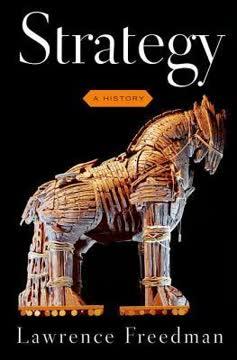
Strategy is one of the most used and least understood words in modern life. We speak of business strategy, political strategy, investment strategy, and even dating strategy. The word has become so elastic that it risks meaning everything and nothing at once. Yet beneath the buzzword lies a profound and ancient human activity: the attempt to achieve desired outcomes in situations where others have their own intentions, their own plans, and their own capacity to resist.
**Author:** Lawrence Freedman
**Estimated Reading Time:** 45 minutes
**What You'll Learn:**
- How strategy emerged from biological necessity and evolved into a sophisticated art - Why deception and cunning have always been central to strategic success - How military strategy transformed from ancient times through Napoleon, Clausewitz, and nuclear deterrence - Why guerrilla warfare represents a fundamentally different strategic logic - How information technology and cognitive warfare are reshaping strategy today - Why strategy is best understood as a dynamic interaction between opposing wills rather than a fixed plan
**Who This Book Is For:**
This book is for anyone who wants to understand strategy beyond buzzwords and business clichés. It is for leaders who must make decisions under uncertainty, students of history and politics, military professionals seeking deeper theoretical grounding, and curious readers who sense that strategy is more than a five-step planning process. If you have ever wondered why some underdogs win, why brilliant plans fail, or how nuclear weapons changed the nature of power, this book will give you a framework for thinking clearly about these questions.
Strategy is one of the most used and least understood words in modern life. We speak of business strategy, political strategy, investment strategy, and even dating strategy. The word has become so elastic that it risks meaning everything and nothing at once. Yet beneath the buzzword lies a profound and ancient human activity: the attempt to achieve desired outcomes in situations where others have their own intentions, their own plans, and their own capacity to resist. Lawrence Freedman's *Strategy: A History* is an ambitious attempt to trace this activity from its evolutionary origins to the complexities of the twenty-first century. The book is not a how-to manual. It is something more valuable: a deep exploration of how strategic thinking has developed across millennia, across cultures, and across domains. Freedman shows that strategy is not a modern invention of business schools or military academies. It is a fundamental feature of social life, rooted in the biological necessity of navigating relationships with others who have minds of their own. The problem Freedman addresses is a persistent one. Human beings have always struggled to achieve their goals in a world that does not simply comply with their wishes. Other people resist, compete, cooperate conditionally, and sometimes act in ways that seem irrational. Organizations face the same challenge at larger scales. Nations confront it in its most extreme form: war. The question at the heart of strategy is deceptively simple: how do we get what we want when others want different things? The reason this question remains so difficult is that strategy is not a problem of engineering. It is not like building a bridge,…
Continue reading in the MinuteRead app
Get the complete 30-minute summary of Strategy
Get the complete summary in the appStrategy is the art of creating power, getting more out of a situation than the starting balance of forces would suggest
Strategy is a dynamic interaction between opposing wills, not a linear plan to be executed.
Deception is central to strategy because perceptions matter as much as physical realities.
War is a continuation of political intercourse. Military means must always serve political ends.
The weaker party can prevail by changing the terms of engagement and refusing to fight on the stronger party's terms.
Deterrence works through the opponent's calculations. The credibility of the threat matters more than the capability its
"Strategy" is a strong fit if you want practical ideas around history, business, politics, especially themes like strategy is the art of creating power, getting more out of a situation than the starting balance of forces would suggest; strategy is a dynamic interaction between opposing wills, not a linear plan to be executed. The MinuteRead summary distills these concepts into a focused read, whether you're deciding whether to buy the book or applying its lessons at work.
Sir Lawrence David Freedman, KCMG, CBE, PC, FBA is a renowned scholar in the field of war studies. As Emeritus Professor at King's College London, he has made significant contributions to strategic theory and international relations. Freedman's work spans military history, nuclear strategy, and contemporary conflicts. He has advised governments and served on official inquiries, including the UK's Iraq War inquiry. Known for his analytical rigor and comprehensive approach, Freedman's writings hav…
View all summaries by Lawrence FreedmanContinue Reading
Access the complete 30-minute summary and thousands more nonfiction books in the MinuteRead app.

Continue reading the complete summary in the MinuteRead app.