MinuteRead
30 min
Book summary
Premium summary · Opens in the app · 30 min read
A father brings his troubled son to a wilderness program for struggling teens. He hopes the program will fix the boy. Instead, he discovers something unsettling: he is part of the problem. Not because of what he did, but because of how he has been seeing his son.
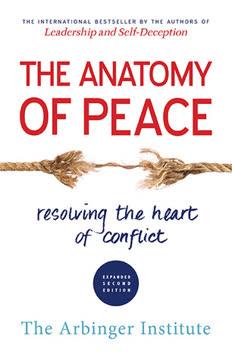
**The Anatomy of Peace** *Resolving the Heart of Conflict*
By The Arbinger Institute
**Estimated Reading Time:** 45 minutes
**What You'll Learn** Why conflicts persist despite our best efforts to solve them, how our own mindset creates the very problems we complain about, and a practical path toward genuine peace in relationships, work, and life.
**Who This Book Is For** Anyone who has ever felt stuck in a conflict that defies resolution. Parents struggling with rebellious teenagers. Leaders frustrated by unmotivated teams. Spouses caught in the same arguments. Professionals navigating toxic workplaces. And anyone who senses that the real problem might be closer to home than they want to admit.
A father brings his troubled son to a wilderness program for struggling teens. He hopes the program will fix the boy. Instead, he discovers something unsettling: he is part of the problem. Not because of what he did, but because of how he has been seeing his son. This is the starting point of The Anatomy of Peace, a book that takes a surprising position on conflict. Most of us believe that problems exist out there, in other people, in circumstances, in systems. We think that if those things would change, everything would be fine. The book challenges this assumption at its root. The central insight is both simple and deeply uncomfortable. When we are in conflict with others, we are almost always carrying that conflict within ourselves first. Our hearts are at war. And a heart at war cannot see clearly. It cannot solve problems. It cannot even recognize its own contribution to the mess. This is not a book about communication techniques or negotiation strategies. It is a book about something more fundamental: the way we see other people. At any given moment, we either see others as people, with hopes and fears and needs as real as our own, or we see them as objects, as obstacles, as tools, as problems to be managed. This choice, made moment by moment, determines the quality of every relationship we have. The book unfolds through a story. A group of parents, each struggling with a difficult child, gather at a wilderness camp run by two men with unusual backgrounds: an Israeli and a Palestinian who found their way out of a bitter conflict. Through their conversations, the parents slowly discover that the conflicts they face at home are not fundamentally different from the conflicts that tear nations apart. The same dynamics are at work. And the same solution applies. What makes this approach different is its refusal to let us off the hook. It does not offer techniques for fixing other people. It offers a way to change ourselves. And in…
Continue reading in the MinuteRead app
Get the complete 30-minute summary of The Anatomy of Peace
Get the complete summary in the appAt every moment, you either see others as people or as objects. This choice shapes everything.
Self-betrayal, ignoring your own sense of what is right, is the seed of all conflict.
You then justify your self-betrayal by finding fault with others, distorting your perception.
You provoke the very behavior you complain about. Your way of seeing invites responses that confirm your view.
The boxes (Better-Than, I-Deserve, Need-to-Be-Seen-As, Worse-Than) are styles of self-justification.
Getting out of the box is a change of heart, not a technique. It begins with recognizing you are in the box.
"The Anatomy of Peace" is a strong fit if you want practical ideas around self help, leadership, psychology—especially themes like at every moment, you either see others as people or as objects. this choice shapes everything; self-betrayal, ignoring your own sense of what is right, is the seed of all conflict. The MinuteRead summary distills these concepts into a focused read, whether you're deciding whether to buy the book or applying its lessons at work.
The Arbinger Institute is a global leadership development organization focused on helping individuals and organizations shift mindsets and transform cultures. Founded by C. Terry Warner, a philosophy professor at Brigham Young University, the Institute's work is based on his ideas about self-deception and conflict resolution. The Anatomy of Peace is their second book, following Leadership and Self-Deception. While not explicitly religious, the Institute's teachings align with Mormon values and h…
View all summaries by The Arbinger InstituteContinue Reading
Access the complete 30-minute summary and thousands more nonfiction books in the MinuteRead app.

Continue reading the complete summary in the MinuteRead app.