MinuteRead
30 min
Book summary
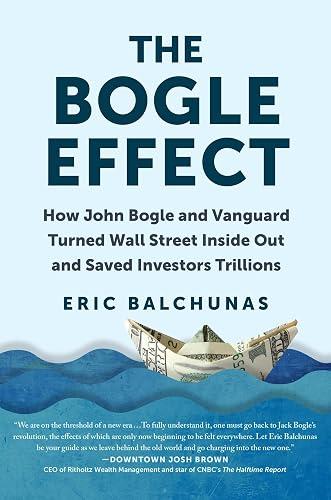
by Eric Balchunas
Premium summary · Opens in the app · 30 min read
In 1975, John Bogle launched a company that Wall Street considered a joke. The idea was so contrary to the prevailing wisdom of the financial industry that competitors dismissed it as naive, unworkable, and possibly un-American. The company was called Vanguard, and its founding principle was radical: the investors who put money into its funds would own the company itself. No outside shareholders. No profit motive beyond serving the people who entrusted their savings to it.
**Author:** Eric Balchunas
**Estimated Reading Time:** 45 minutes
**What You'll Learn:**
How one man's radical idea about putting investors first transformed the entire financial industry, saved ordinary people trillions of dollars, and created a new way of thinking about money that continues to reshape markets today.
**Who This Book Is For:**
Anyone who has ever wondered why investment fees matter, whether active fund managers can beat the market, or how the quiet revolution in low-cost investing changed the rules of the game for everyone from first-time savers to institutional portfolio managers.
In 1975, John Bogle launched a company that Wall Street considered a joke. The idea was so contrary to the prevailing wisdom of the financial industry that competitors dismissed it as naive, unworkable, and possibly un-American. The company was called Vanguard, and its founding principle was radical: the investors who put money into its funds would own the company itself. No outside shareholders. No profit motive beyond serving the people who entrusted their savings to it. The financial establishment had good reason to scoff. For decades, the investment industry had operated on a simple premise: managing money was a lucrative business, and the people who did it deserved to be paid handsomely. Fund managers were celebrities. Their stock picks made headlines. Their performance, when good, attracted floods of new money. When bad, investors were expected to simply try another manager. The idea that investors might be better served by not trying to beat the market at all seemed absurd. But Bogle saw something the rest of the industry refused to acknowledge. The math of investing, stripped of its mystique and marketing, revealed an uncomfortable truth: most active managers failed to beat the market over time, and the fees they charged made their underperformance even worse. The entire edifice of professional money management, with its research departments and trading desks and performance bonuses, was built on a foundation that crumbled under scrutiny. What Bogle proposed instead was almost embarrassingly simple. Instead of trying to beat the market, why not simply own the market? Instead of paying high fees for the promise of superior returns, why not pay minimal fees for the guarantee of average returns? And instead of enriching a company's shareholders, why not structure the enterprise so that the investors themselves benefited from every dollar saved? The result was the index fund, an invention that would eventually be called the most successful financial innovation of the twentieth century. But the index fund was only part of the story. The deeper revolution was in the structure of Vanguard itself. By making the fund investors the owners of the company, Bogle created an alignment of interests that had never existed before…
Continue reading in the MinuteRead app
Get the complete 30-minute summary of The Bogle Effect
Get the complete summary in the appCosts matter more than almost anything else in investing. Every dollar paid in fees is a dollar that does not compound i
The structure of an investment company determines whose interests it serves. Vanguard's mutual ownership structure align
Beating the market is a zero-sum game that most investors lose after costs. The average active investor must underperfor
Index funds capture the market's return at minimal cost. Over long periods, they outperform most actively managed funds.
The Great Cost Migration has shifted trillions of dollars from high-cost to low-cost funds, forcing the entire industry
The biggest obstacle to investment success is not the market but the investor. The behavior gap destroys returns more ef
"The Bogle Effect" is a strong fit if you want practical ideas around finance, business, economics, especially themes like costs matter more than almost anything else in investing. every dollar paid in fees is a dollar that does not compound i; the structure of an investment company determines whose interests it serves. vanguard's mutual ownership structure align. The MinuteRead summary distills these concepts into a focused read, whether you're deciding whether to buy the book or applying its lessons at work.
Motivated to help readers with "My goal was to create an enterprise that was only of the shareholder, Eric Balchunas wrote “The Bogle Effect” to package those ideas for a fast, focused read. In “The Bogle Effect”, Eric Balchunas focuses on "My goal was to create an enterprise that was only of the shareholder. Through “The Bogle Effect”, Eric Balchunas distills the core ideas on finance into lessons readers can absorb in a single short sitting. Readers turn to this work when they want Eric Balchu…
Continue Reading
Access the complete 30-minute summary and thousands more nonfiction books in the MinuteRead app.

Continue reading the complete summary in the MinuteRead app.