MinuteRead
30 min
Book summary
Premium summary · Opens in the app · 30 min read
Every organization has a hidden asset that never appears on its balance sheet. It is not inventory. It is not intellectual property in the legal sense. It is not even the collective resumes of its employees. This asset is the accumulated knowledge of how things actually get done: the unwritten rules, the hard-won insights, the relationships that make things happen, the lessons learned from failures that no one wants to repeat.
**Author:** Melissie Clemmons Rumizen **Estimated Reading Time:** 45 minutes
This condensed edition teaches you how organizations capture, share, and leverage what their people know. You will learn why some companies consistently outperform their competitors not because they have smarter employees but because they have better systems for turning individual knowledge into collective wisdom. You will discover how to identify the knowledge that matters most, how to prevent critical expertise from walking out the door, and how to build a culture where sharing knowledge becomes natural rather than forced. You will also learn how to measure whether your knowledge management efforts are actually working and how to avoid the common mistakes that cause most knowledge initiatives to fail.
This book is for managers who worry about losing institutional knowledge when experienced employees retire. It is for leaders who want to stop reinventing the wheel in every project and start building on what their organization already knows. It is for professionals who recognize that their company's most valuable asset is not its equipment, its patents, or its real estate but the accumulated expertise of its people. And it is for anyone who has ever watched a brilliant colleague leave and thought, "We just lost something we can never replace."
Every organization has a hidden asset that never appears on its balance sheet. It is not inventory. It is not intellectual property in the legal sense. It is not even the collective resumes of its employees. This asset is the accumulated knowledge of how things actually get done: the unwritten rules, the hard-won insights, the relationships that make things happen, the lessons learned from failures that no one wants to repeat. When this knowledge stays locked inside individual minds, organizations operate far below their potential. Projects take longer than they should because teams cannot learn from previous efforts. Mistakes recur because the people who made them never shared what they learned. New employees struggle for months or years to reach the productivity levels of the colleagues they replaced. When experienced people leave, they take with them knowledge that may have taken decades to accumulate. This is the problem that knowledge management exists to solve. Melissie Clemmons Rumizen wrote this book because she recognized a fundamental gap in how organizations think about knowledge. Most companies invest heavily in technology, in training, in hiring the best people they can find. But few invest systematically in ensuring that what their people know becomes an organizational asset rather than merely an individual one. The result is that organizations repeatedly lose knowledge they already paid to acquire. The challenge is not that knowledge management is conceptually difficult. The challenge is that it requires a different way of thinking…
Continue reading in the MinuteRead app
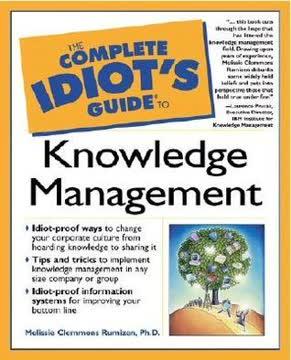
Get the complete 30-minute summary of The Complete Idiot's Guide to Knowledge Management
Get the complete summary in the appKnowledge management is about enabling the flow of knowledge from those who have it to those who need it. It is not prim
The most valuable knowledge is tacit: it resides in people's heads and transfers primarily through direct interaction, n
Culture is the foundation of knowledge management. If the culture does not support sharing, no system will make it happe
Leadership is the single most important factor. Leaders must model knowledge sharing, not just talk about it.
Focus on the knowledge that matters most. Not all knowledge is equally valuable. Identify the knowledge that differentia
Communities of practice are powerful because they create sustained opportunities for tacit knowledge transfer through co
"The Complete Idiot's Guide to Knowledge Management" is a strong fit if you want practical ideas around management, business, especially themes like knowledge management is about enabling the flow of knowledge from those who have it to those who need it. it is not prim; the most valuable knowledge is tacit: it resides in people's heads and transfers primarily through direct interaction, n. The MinuteRead summary distills these concepts into a focused read, whether you're deciding whether to buy the book or applying its lessons at work.
Melissie Clemmons Rumizen is the author of The Complete Idiot's Guide to Knowledge Management . She is recognized as an expert in the field of knowledge management, with experience in both academic and practical applications. Rumizen's writing style is noted for its accessibility, making complex topics easier to understand for beginners and non-specialists. Her approach to knowledge management emphasizes practical implementation strategies for organizations. Rumizen's work in this field has cont…
View all summaries by Melissie Clemmons RumizenContinue Reading
Access the complete 30-minute summary and thousands more nonfiction books in the MinuteRead app.

Continue reading the complete summary in the MinuteRead app.