MinuteRead
30 min
Book summary
Premium summary · Opens in the app · 30 min read
There is a peculiar form of suffering that almost everyone recognizes but few can name. It happens at 10:47 on a Tuesday morning when you have a report due at noon. Instead of writing the report, you find yourself reorganizing your desk drawer. Then you check your email. Then you read an article about productivity. Then you feel terrible about reading an article about productivity instead of writing the report. Then you check your email again.
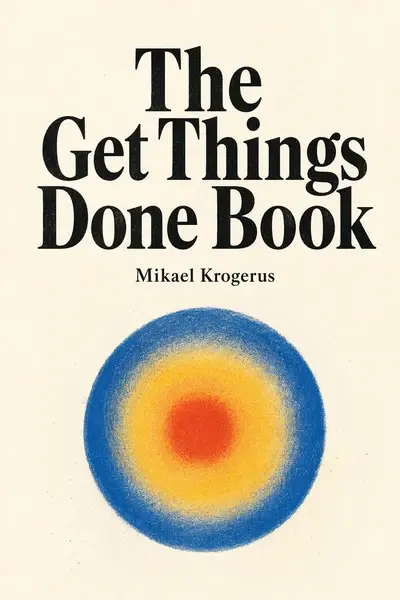
**Author:** Mikael Krogerus
**Estimated Reading Time:** 42 minutes
**What You'll Learn:** - Why procrastination is not a character flaw but a solvable psychological puzzle - How to focus intensely in an age of constant distraction - Practical systems for managing projects, communication, and feedback - How to design a life that sustains energy over decades, not just days - Frameworks for evaluating work objectively and learning from experience
**Who This Book Is For:** Anyone who has ever stared at a to-do list and felt paralyzed. Anyone who has confused busyness with productivity. Anyone who suspects that the way we work is broken and wants practical tools to fix it. This book is for people who want to understand the mechanics of getting things done, not just motivational slogans.
There is a peculiar form of suffering that almost everyone recognizes but few can name. It happens at 10:47 on a Tuesday morning when you have a report due at noon. Instead of writing the report, you find yourself reorganizing your desk drawer. Then you check your email. Then you read an article about productivity. Then you feel terrible about reading an article about productivity instead of writing the report. Then you check your email again. This is not laziness. Lazy people do not feel guilty about avoiding work. They simply avoid it and feel fine. The person who procrastinates feels something closer to paralysis. They know exactly what they should be doing. They want to do it. And yet they cannot seem to begin. Mikael Krogerus wrote The Get Things Done Book to address this specific form of modern suffering. The book is not a collection of motivational platitudes. It is a practical investigation into why we avoid important tasks and what we can do about it. Krogerus draws on psychology, management theory, and his own experience as a journalist and creative professional to build a toolkit for action. The problem the book addresses is urgent because the modern world has made procrastination easier than ever. We carry distraction machines in our pockets. Our work is increasingly cognitive and self-directed, which means no one is standing over us ensuring we stay on task. The structures that once imposed discipline, offices with managers, fixed schedules, clear hierarchies, have eroded. We are left to manage our own attention in an environment designed to fragment it. Krogerus understands that this is not simply a matter of willpower. The human brain is not a single unified decision-maker. It is a collection of competing systems, some of which care about long-term goals and some of which care only about immediate comfort. Procrastination happens when the immediate comfort system wins. The solution is not to berate yourself…
Continue reading in the MinuteRead app
Get the complete 30-minute summary of The Get Things Done Book
Get the complete summary in the appProcrastination is an emotion regulation problem, not a character flaw. Address the underlying emotion rather than berat
Ask the four questions when you are stuck: How will you feel if you do not complete this? What would a productive person
Use the Pomodoro Technique: 25 minutes of focused work, 5 minutes of rest, repeat.
Compartmentalize your life. Give full attention to one area at a time.
Prototype before you perfect. Build rough versions quickly and test them.
Batch your communication. Check email at designated times, not constantly.
"The Get Things Done Book" is a strong fit if you want practical ideas around productivity, self help, psychology, especially themes like procrastination is an emotion regulation problem, not a character flaw. address the underlying emotion rather than berat; ask the four questions when you are stuck: how will you feel if you do not complete this? what would a productive person. The MinuteRead summary distills these concepts into a focused read, whether you're deciding whether to buy the book or applying its lessons at work.
Mikael Krogerus is a versatile writer with a diverse background in journalism and advertising. Born in Finland and raised in Sweden and Germany, he brings a multicultural perspective to his work. Krogerus spent five years as a staff writer for NZZ FOLIO, the supplement magazine of Switzerland's prominent newspaper, Neue Zürcher Zeitung. Before that, he worked as a copywriter in various advertising agencies. His educational background includes graduating from the Kaospilot School, known for its i…
View all summaries by Mikael KrogerusContinue Reading
Access the complete 30-minute summary and thousands more nonfiction books in the MinuteRead app.

Continue reading the complete summary in the MinuteRead app.