MinuteRead
30 min
Book summary
Premium summary · Opens in the app · 30 min read
In the spring of 2006, while most Americans were enjoying the fruits of a booming housing market, a little-known money manager named John Paulson sat in his midtown Manhattan office staring at charts that made no sense to him.
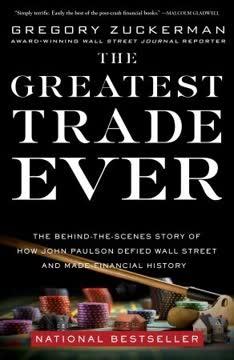
**Author:** Gregory Zuckerman
**Estimated Reading Time:** 45 minutes
**What You'll Learn:** How a relatively unknown hedge fund manager named John Paulson identified the housing bubble, constructed a massive bet against subprime mortgages, and earned one of the largest fortunes in Wall Street history. You will also learn about the broader cast of characters who saw the crisis coming, the financial machinery that made it possible, and the human cost of the collapse.
**Who This Book Is For:** Anyone interested in financial markets, contrarian thinking, risk management, or understanding how the 2008 financial crisis unfolded. This condensed edition is written for readers who want to understand the mechanics of the greatest trade ever made without wading through hundreds of pages of financial detail.
In the spring of 2006, while most Americans were enjoying the fruits of a booming housing market, a little-known money manager named John Paulson sat in his midtown Manhattan office staring at charts that made no sense to him. Home prices had risen more than 180 percent in some markets over the previous decade. Lenders were handing out mortgages to people with no income, no jobs, and no assets. Wall Street was packaging these loans into securities and selling them to investors around the world as if they were as safe as government bonds. And yet, almost nobody seemed worried. Paulson was worried. He was not a housing expert. He had never traded mortgages. He had spent most of his career quietly managing money for wealthy clients, specializing in merger arbitrage, a relatively conservative strategy that involved betting on the outcomes of corporate takeovers. He was known on Wall Street as a competent but unremarkable investor, someone who generated steady returns without making headlines. But the data he was seeing told a story that contradicted everything the market believed. Housing prices were beginning to stall. Mortgage delinquencies were rising. The exotic loans that had fueled the boom were about to reset at higher interest rates, and millions of borrowers would soon be unable to make their payments. Paulson realized something that almost no one else on Wall Street had grasped: the entire housing market was built on a foundation of sand. What followed was one of the most remarkable investment stories in financial history. Paulson and his small team constructed a series of trades that would profit enormously if the housing market collapsed. They used complex financial instruments called credit default swaps to bet against subprime mortgages. They faced skepticism from investors, ridicule from peers, and months of agonizing losses while they waited for the market to catch up with reality. When the collapse finally came, the payoff was staggering. Paulson's firm made $15 billion in 2007 alone.…
Continue reading in the MinuteRead app
Get the complete 30-minute summary of The Greatest Trade Ever
Get the complete summary in the appQuestion consensus views, especially when they are based on recent experience rather than fundamental analysis.
Follow the data wherever it leads, even when the conclusion is uncomfortable.
Structure contrarian bets so that your downside is limited and your upside is large.
Be prepared to be early. The market can stay irrational longer than you can stay solvent.
Conviction comes from analysis, not from the opinions of others.
Securitization separates risk from originators, creating moral hazard.
"The Greatest Trade Ever" is a strong fit if you want practical ideas around finance, business, economics, especially themes like question consensus views, especially when they are based on recent experience rather than fundamental analysis; follow the data wherever it leads, even when the conclusion is uncomfortable. The MinuteRead summary distills these concepts into a focused read, whether you're deciding whether to buy the book or applying its lessons at work.
Gregory Zuckerman is a Special Writer at The Wall Street Journal and a three-time Gerald Loeb award winner. He has authored six books, including "The Greatest Trade Ever" about John Paulson's successful bet against the housing market. Zuckerman's other works cover topics like COVID-19 vaccine development, quantitative trading, and inspiring athletes. With 25 years of experience at the WSJ, he specializes in financial journalism and has established himself as a respected author in the field. Zuck…
View all summaries by Gregory ZuckermanContinue Reading
Access the complete 30-minute summary and thousands more nonfiction books in the MinuteRead app.

Continue reading the complete summary in the MinuteRead app.