MinuteRead
30 min
Book summary
by Frank J. Fabozzi
Premium summary · Opens in the app · 30 min read
The fixed income market is the largest securities market in the world. It dwarfs the equity markets in size, yet it receives a fraction of the attention. Most investors can name dozens of stocks, but struggle to explain how a bond actually works. This asymmetry creates both a problem and an opportunity.
**Author:** Frank J. Fabozzi
**Estimated Reading Time:** 45 minutes
**What You'll Learn:**
- The complete architecture of fixed income markets and the securities that inhabit them - How to price bonds using present value mathematics and interpret yield measures correctly - The full spectrum of investment risks and how to quantify them - How duration and convexity work as practical tools for managing interest rate exposure - The distinct characteristics of Treasury, agency, municipal, corporate, and mortgage-backed securities - How the yield curve functions as both a valuation tool and a strategic instrument - How data science is reshaping credit analysis and portfolio management
**Who This Book Is For:**
This condensed edition serves investment professionals who need a rigorous foundation in fixed income analysis, portfolio managers seeking to deepen their understanding of risk measurement, analysts transitioning into credit markets, and serious individual investors who want to move beyond superficial explanations. If you have ever wondered how bond markets actually function beneath the surface, this book will give you the working knowledge to participate with confidence.
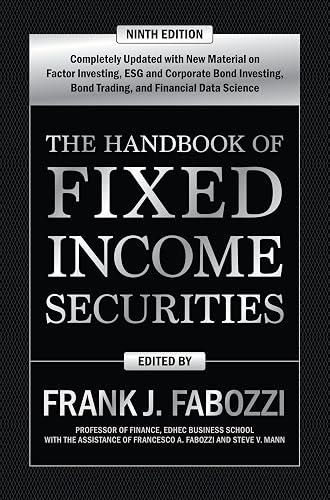
The fixed income market is the largest securities market in the world. It dwarfs the equity markets in size, yet it receives a fraction of the attention. Most investors can name dozens of stocks, but struggle to explain how a bond actually works. This asymmetry creates both a problem and an opportunity. The problem is that fixed income securities have become extraordinarily complex. What was once a simple promise to pay interest and return principal has evolved into a universe of instruments with embedded options, floating coupons, inflation adjustments, prepayment uncertainty, and credit structures that require sophisticated analysis. The investor who treats all bonds as essentially identical is making a dangerous mistake. The opportunity is that this complexity rewards genuine understanding. The investor who masters the concepts in this book gains access to income streams, risk profiles, and portfolio strategies that remain invisible to those who never look beneath the surface. Frank Fabozzi wrote The Handbook of Fixed Income Securities to serve as the definitive reference for this market. The original work spans over a thousand pages and draws on contributions from dozens of practitioners and academics. It has become the standard text for fixed income professionals worldwide. This condensed edition preserves the essential framework while making the material accessible to a broader audience. The book addresses a fundamental challenge: how do you value a promise? When you buy a bond, you are purchasing a stream of future cash flows. Those cash flows depend on interest rates, credit conditions, prepayment behavior, tax policy, and countless other variables. Understanding how these factors interact is the core intellectual challenge of fixed income analysis. The stakes are high.…
Continue reading in the MinuteRead app
Get the complete 30-minute summary of The Handbook of Fixed Income Securities
Get the complete summary in the appA bond's value equals the present value of its expected cash flows, discounted at a rate that reflects their risk.
The issuer's identity is the first determinant of a bond's risk profile, and different issuers create fundamentally diff
Fixed income risk extends far beyond default risk to include interest-rate risk, reinvestment risk, inflation risk, and
The Treasury yield curve provides the benchmark for pricing all other fixed income securities, and spreads represent the
Duration measures interest-rate sensitivity, and convexity captures the curvature of the price-yield relationship.
Municipal bonds offer tax advantages that must be evaluated through the taxable equivalent yield, but tax benefits do no
"The Handbook of Fixed Income Securities" is a strong fit if you want practical ideas around finance, business, economics, especially themes like a bond's value equals the present value of its expected cash flows, discounted at a rate that reflects their risk; the issuer's identity is the first determinant of a bond's risk profile, and different issuers create fundamentally diff. The MinuteRead summary distills these concepts into a focused read, whether you're deciding whether to buy the book or applying its lessons at work.
Motivated to help readers with one important characteristic of a bond is the nature of its issuer, Frank J. Fabozzi wrote “The Handbook of Fixed Income Securities” to package those ideas for a fast, focused read. In “The Handbook of Fixed Income Securities”, Frank J. Fabozzi focuses on one important characteristic of a bond is the nature of its issuer. Through “The Handbook of Fixed Income Securities”, Frank J. Fabozzi distills the core ideas on finance into lessons readers can absorb in a singl…
Continue Reading
Access the complete 30-minute summary and thousands more nonfiction books in the MinuteRead app.

Continue reading the complete summary in the MinuteRead app.