MinuteRead
30 min
Book summary
Premium summary · Opens in the app · 30 min read
Imagine standing in front of an open refrigerator at midnight. You are not hungry. You ate dinner three hours ago. You have plans to exercise tomorrow morning. You know, with absolute certainty, that eating the leftover pizza will not help you reach your goals. Yet your hand reaches for the container anyway.
**Author:** Stephan Guyenet **Estimated Reading Time:** 42 minutes
**What You'll Learn:**
* Why your brain is wired to overeat, even when you consciously want to stop * How food reward circuits hijack your decision-making without your awareness * Why modern processed foods are engineered to be irresistible * How sleep, stress, and genetics influence your eating behavior * Practical strategies to work with your brain rather than against it
**Who This Book Is For:**
Anyone who has ever wondered why they keep eating when they know they should stop. Anyone who has struggled with weight loss and felt like their own brain was sabotaging them. Anyone curious about the neuroscience of eating behavior and why the modern food environment makes healthy choices so difficult.
Imagine standing in front of an open refrigerator at midnight. You are not hungry. You ate dinner three hours ago. You have plans to exercise tomorrow morning. You know, with absolute certainty, that eating the leftover pizza will not help you reach your goals. Yet your hand reaches for the container anyway. This moment, repeated in countless variations across millions of lives, contains a profound mystery. Why do we eat when we do not need to eat? Why do we choose foods we know will harm us? Why does knowledge about nutrition so rarely translate into action? Stephan Guyenet spent his career investigating these questions. As a neuroscientist studying obesity, he came to a conclusion that challenges much of what we believe about eating behavior. The problem is not a lack of willpower. The problem is not a character flaw. The problem is that our brains evolved for a world that no longer exists. For most of human history, food was scarce. Our ancestors spent their days hunting, gathering, and foraging. Calories were precious. The brain evolved sophisticated systems to ensure that when food was available, especially calorie-dense food, we would eat as much as possible. These systems operated below conscious awareness. They still do. The modern food environment presents our ancient brains with an unprecedented challenge. We are surrounded by foods engineered to be more rewarding than anything our ancestors encountered. We can obtain thousands of calories with minimal effort. Our brains, still operating on ancient programming, respond by driving us to eat more than we need. This is not a moral failing. It is biology. Guyenet's work integrates neuroscience, evolutionary biology, physiology, and nutrition science to explain why we overeat and what we can do about it. He shows that the brain's nonconscious circuits, not conscious choice, drive most eating behavior. Understanding these circuits is the first step toward working with them. The book addresses a fundamental tension. We consciously want to be healthy.…
Continue reading in the MinuteRead app
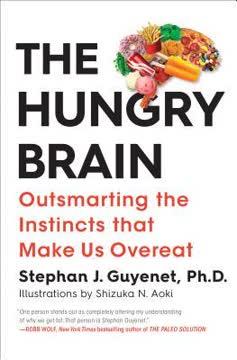
Get the complete 30-minute summary of The Hungry Brain
Get the complete summary in the appYour eating behavior is controlled primarily by nonconscious brain circuits shaped by evolution for food scarcity.
Dopamine reinforces behaviors associated with calorie acquisition, creating powerful drives to eat high-calorie foods.
The modern food environment exploits your brain's vulnerabilities through engineered foods that trigger maximum reward r
Your brain evaluates food options based on calories and effort, making convenience foods highly attractive.
The lipostat defends body weight against loss, making weight loss difficult and weight regain common.
Sleep deprivation disrupts eating behavior by increasing hunger, increasing food reward, and impairing impulse control.
"The Hungry Brain" is a strong fit if you want practical ideas around health & fitness, health, science, especially themes like your eating behavior is controlled primarily by nonconscious brain circuits shaped by evolution for food scarcity; dopamine reinforces behaviors associated with calorie acquisition, creating powerful drives to eat high-calorie foods. The MinuteRead summary distills these concepts into a focused read, whether you're deciding whether to buy the book or applying its lessons at work.
Stephan J. Guyenet, Ph.D. is an obesity researcher and health writer with expertise in neuroscience, physiology, evolutionary biology, and nutrition. He earned a B.S. in biochemistry from the University of Virginia and a Ph.D. in neurobiology from the University of Washington. Guyenet's work focuses on explaining and addressing the global obesity crisis by integrating insights from various scientific disciplines. He is known for his popular health website, Whole Health Source, and frequently spe…
View all summaries by Stephan GuyenetContinue Reading
Access the complete 30-minute summary and thousands more nonfiction books in the MinuteRead app.

Continue reading the complete summary in the MinuteRead app.