MinuteRead
30 min
Book summary
Premium summary · Opens in the app · 30 min read
Most investment books begin with a promise. They promise a formula, a secret, a shortcut to market-beating returns. They offer screens and ratios and technical indicators that will supposedly unlock the mysteries of the market. And most of them fail to deliver, not because their authors are dishonest, but because they are answering the wrong question.
**Author:** Michael Shearn
**Estimated Reading Time:** 45 minutes
**What You'll Learn:**
* How to generate investment ideas systematically instead of randomly * A complete framework for understanding any business deeply * How to evaluate management quality beyond the numbers * Why customer analysis reveals more than financial statements * How to assess competitive advantages and their durability * A practical checklist for avoiding costly investment mistakes
**Who This Book Is For:**
This book is for individual investors who want to move beyond surface-level stock picking. It is for people who have realized that reading financial statements is not enough, that understanding a business requires deeper investigation, and that the best investors are not necessarily the smartest but the most disciplined. Whether you manage your own portfolio or simply want to understand how great businesses work, this book provides a systematic approach to thinking about investments.
Most investment books begin with a promise. They promise a formula, a secret, a shortcut to market-beating returns. They offer screens and ratios and technical indicators that will supposedly unlock the mysteries of the market. And most of them fail to deliver, not because their authors are dishonest, but because they are answering the wrong question. The question most investors ask is: What should I buy? Michael Shearn asks a different question: How do I understand what I am buying? This distinction matters more than it first appears. When you ask what to buy, you are looking for a recommendation. You want someone to tell you the answer. But when you ask how to understand what you are buying, you are building a skill. You are learning to think for yourself. And in investing, thinking for yourself is the only sustainable edge. Shearn wrote The Investment Checklist after spending more than a decade researching companies, attending industry conferences, reading thousands of SEC filings, and studying the habits of successful investors. What he discovered was both simple and profound. The best investors do not rely on intuition. They do not trust their gut. They follow a process. They work through a systematic evaluation of every aspect of a business before committing capital. The problem with intuition is that it is unreliable. Cognitive biases distort our thinking. We fall in love with stories. We anchor on recent performance. We follow the crowd. We overestimate our ability to predict the future. A checklist is a defense against these tendencies. It forces us to slow down, to examine evidence, to ask uncomfortable questions. But a checklist is only as good as the questions it contains. And this is where Shearn's contribution stands out. Most investment checklists focus on financial metrics. Is the price-to-earnings ratio reasonable? Is the balance sheet…
Continue reading in the MinuteRead app
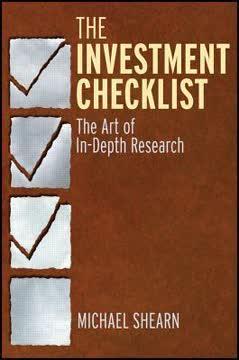
Get the complete 30-minute summary of The Investment Checklist
Get the complete summary in the appGenerate investment ideas systematically, not randomly. The best opportunities come in waves.
Never invest in a business you do not understand. If you cannot explain how it makes money, pass.
Evaluate businesses from the customer's perspective. Customer quality determines business quality.
Look for durable competitive advantages. The more sustainable the advantage, the more the business is worth.
Focus on return on invested capital. It reveals whether a business is creating or destroying value.
Evaluate management's character, not just their competence. Integrity and passion matter.
"The Investment Checklist" is a strong fit if you want practical ideas around finance, business, money, especially themes like generate investment ideas systematically, not randomly. the best opportunities come in waves; never invest in a business you do not understand. if you cannot explain how it makes money, pass. The MinuteRead summary distills these concepts into a focused read, whether you're deciding whether to buy the book or applying its lessons at work.
Michael Shearn is an experienced investor based in Texas who has developed a systematic approach to investment analysis. He created The Investment Checklist based on over a decade of experience in researching and evaluating companies. Michael Shearn emphasizes the importance of thorough qualitative analysis, particularly in assessing management quality and business fundamentals. His investment philosophy aligns with value investing principles, focusing on long-term holdings and understanding bus…
View all summaries by Michael ShearnContinue Reading
Access the complete 30-minute summary and thousands more nonfiction books in the MinuteRead app.

Continue reading the complete summary in the MinuteRead app.